
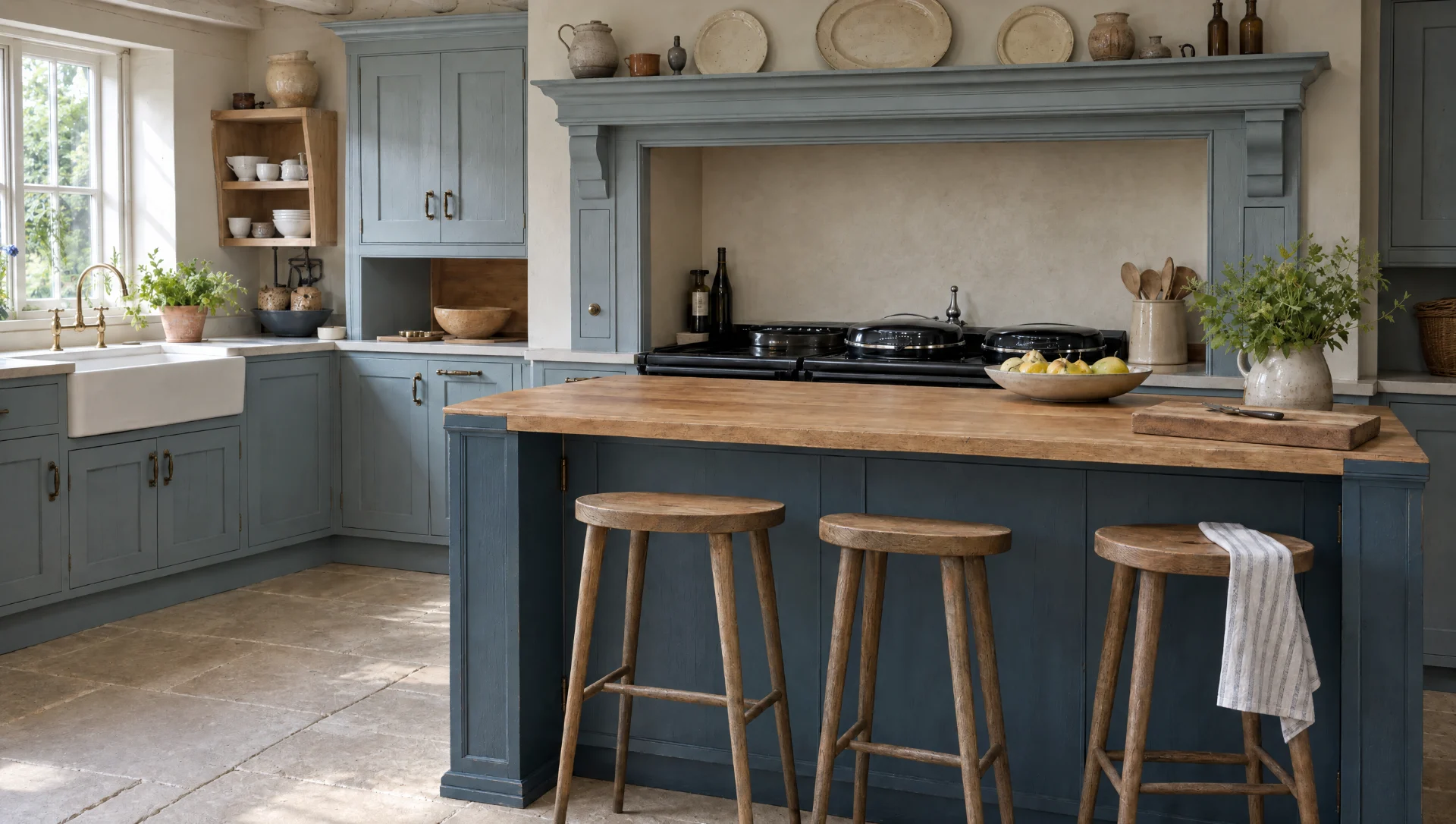
What a bespoke kitchen costs in 2026
Our kitchens start at £35,000 and most land between £65,000 and £120,000. Here is what sits inside that number and what moves it.
The floor, and why it is where it is
Our fitted kitchens start at £35,000. That is not a positioning decision, it is the point below which we cannot do the work the way this workshop does it.
A modest kitchen — say fourteen cabinets, an island, a run of tall units — is several hundred hours of labour here, and the largest single block of it is not the machining. It is the bench assembly and then the finishing, because paint is slower than everybody expects. Add timber, ironmongery, runners and hinges, and the number arrives where it arrives.
Below £35,000 the only ways to get there are to buy in carcasses, to spray instead of brush, or to fit in a day and leave the gaps. All three are legitimate businesses. None of them is this one.
Where the money actually goes
On a typical £85,000 commission, before appliances and stone, the split looks like this.
Cabinetry — timber, sheet material, machining and bench work — 55 to 60 per cent. This is the bulk and it scales almost directly with the number of cabinets and the amount of frame.
Finishing, 12 to 15 per cent. Four brushed coats with denibbing between them, or a two-pack sprayed system, both done here in a controlled room. A large kitchen occupies our finishing room for close to three weeks.
Installation, 8 to 12 per cent. Two men, three to seven days, plus accommodation and travel if you are more than an hour or so from Mickfield.
Ironmongery, 5 to 8 per cent, and this one surprises people. Solid unlacquered brass cup handles are £30 to £55 each; a kitchen may take forty of them. Butt hinges in drawn brass are £25 to £40 a pair. Good runners are £40 to £70 a drawer.
Design and setting out, 5 per cent, of which the £500 consultation fee is a part and is credited back.
Everything else — delivery, protection, waste, the two or three small things that always need remaking — the rest.
The five things that move the number
The number of cabinets, obviously, but less than you would think. Cabinets do not cost by the metre; they cost by the piece. Two 450mm cupboards cost noticeably more than one 900mm one, because the frame, the doors, the hinges and the fitting all double while the volume stays the same. Fewer, larger cabinets is the single most effective economy available and it usually produces a better room.
In-frame versus handle-less. A face frame adds roughly a day per run in machining and bench work, and hand-fitting each door into its aperture adds forty minutes a door. Across a kitchen that is £6,000 to £10,000 of difference on otherwise identical work.
Brushed versus sprayed. Hand-painting is slower than spraying by a factor of about two. Spraying needs a booth, extraction, and a surface flat enough to survive being lit evenly, which pushes cost back the other way in preparation. They are closer than people assume.
Curved and carved work. A curved island end in solid timber — coopered, laminated or bricked and shaped — is three to five days of one person’s time. A carved corbel is a day. A moulding we do not already have a block ground for is £200 to £400 in tooling before a single length is run, though that block then belongs to your house forever.
The house itself. A new extension with plumb walls and a level floor fits in three days. A Grade II* farmhouse with 30mm of lean and a floor that falls fifty across the room takes six, plus a survey visit, plus scribe material we machine and then cut away.
What is not in the number
Appliances. Most of our clients spend £8,000 to £25,000, and a range cooker with proper extraction can be half of that on its own. We will supply them at trade if you want the single point of responsibility, or you can buy them yourself and we will build to the dimensions.
Worktops. Stone is templated after the cabinets are in and comes from specialist fabricators: £4,000 to £9,000 for a normal kitchen in quartz or granite, £8,000 to £18,000 in marble, quartzite or sintered stone with mitred edges and a large island. Timber worktops we make ourselves and they sit inside the cabinetry number.
Building work, electrics, plumbing, plastering, flooring and decoration. We will coordinate with whoever is doing them and we will provide setting-out drawings for services eight weeks before we arrive.
VAT, which we quote separately and which is 20 per cent on a kitchen in an existing house. New-build has its own treatment and your contractor will confirm it; do not assume a listed building is zero-rated, because the relief for approved alterations to protected buildings was withdrawn in 2012, in which case your architect will tell you before we do.
Two real shapes of job
A three-bedroom Victorian terrace, single-fronted, kitchen across the back. The Suffolk, hand-painted in one colour, eleven cabinets, a 2,100mm island, no scullery, oak worktops on the perimeter and quartz on the island. Cabinetry and finishing £46,000, installation £5,200, ironmongery £3,100. Total from us £54,300, plus £6,800 of stone and around £11,000 of appliances they bought themselves.
A former rectory, listed, kitchen plus scullery plus a boot-room bench. The Essex, two colours, main kitchen plus scullery plus a boot room bench, twenty-nine cabinets, a dresser, a 3,000mm island with a coopered end, a moulding matched to the hall architrave and listed building consent in the background. Cabinetry and finishing £96,000, installation £11,500 over eight days, ironmongery £7,400, tooling for the matched moulding £340. Total from us £115,240.
Both were the right amount of money for what they were. Neither client spent a penny on something they could not point at.
How to spend less without buying worse
Fewer and larger cabinets. Fewer doors, fewer hinges, fewer handles, more usable space.
One colour rather than two. A second colour is a second set-up in the finishing room and typically £1,500 to £3,000.
Timber worktops on the perimeter and stone only where it earns its place, usually the island and behind the hob.
Simplify the island before you simplify the walls. Islands attract expensive ideas: a stone waterfall end, a curved seating return, a second sink, integrated sockets. Each of those is real money and only one of them will be used daily.
Do not economise on the drawer boxes, the runners or the hinges. They are 8 per cent of the price and they are what you touch forty times a day.
Start a conversation
Tell us about the room, the house and roughly when you would like to be cooking in it. We will tell you honestly whether we are the right people for it.
Make an enquiry