
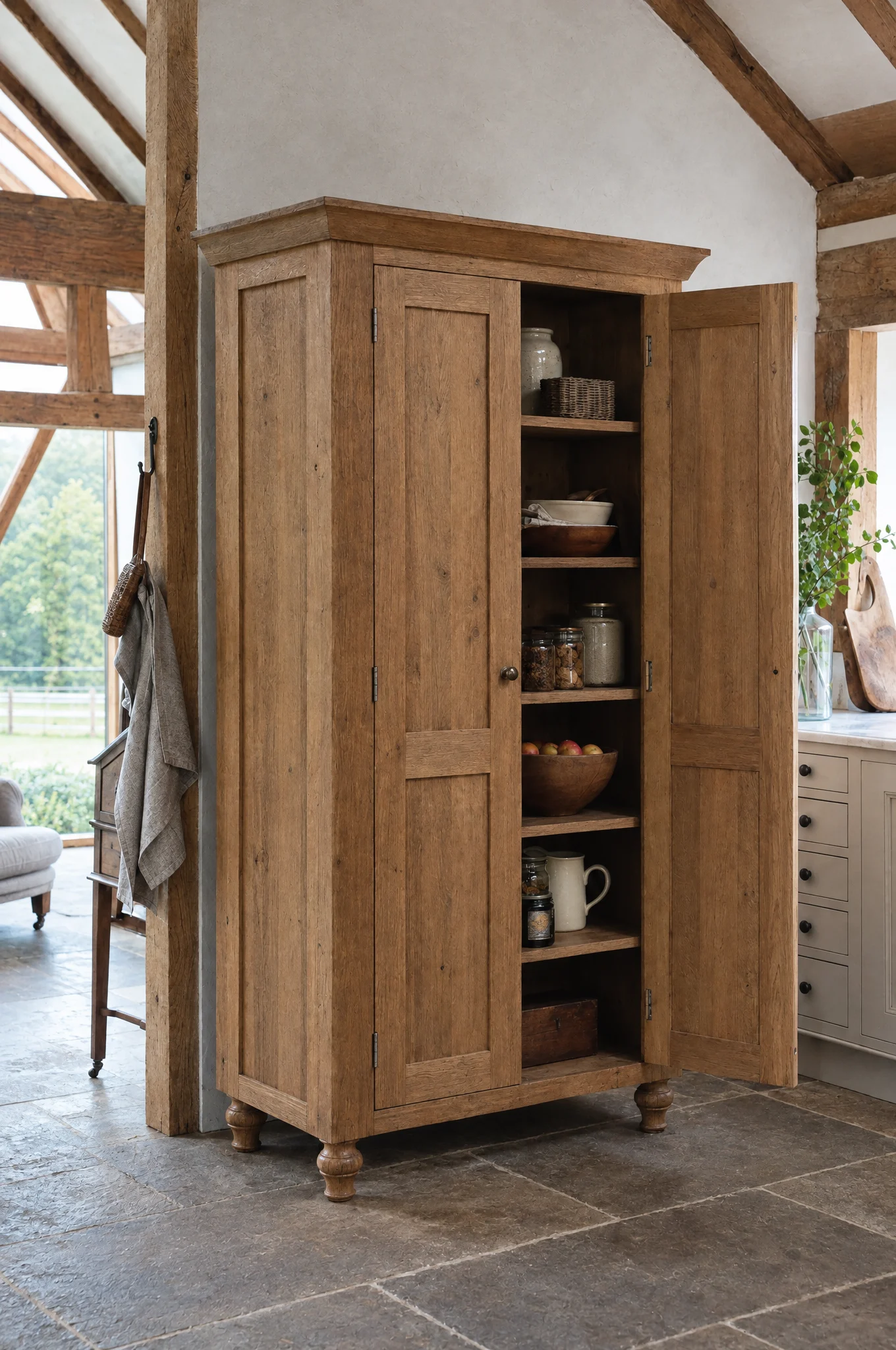
A note on the photograph. The image above shows a residential bar and drinks room with bottle shelving; it is not a dedicated climate-controlled wine room. It illustrates the cabinetmaking end of the work. The guidance below applies to wine cabinets, cellars and purpose-built wine rooms alike.
Three answers, in order of cost
Under about two hundred bottles, and if most of them are drunk within a year, the right answer is usually a conditioned cabinet built into joinery. It costs a fraction of a room and it works.
If the house has a cellar, a vaulted undercroft or a north-facing basement, use it. A passive cellar that sits between 11 and 14 degrees all year needs racking and a light, not a refrigeration plant. Measure it over twelve months before you spend anything.
A purpose-built room is for a collection that is being kept rather than consumed, or for a house where the wine is meant to be seen. It is a small insulated building inside your house with a cooling unit on it, and it should be designed as one.
Conditions
11 to 14 degrees is the target. Stability matters more than the number: a steady 15 does less harm than a swing between 10 and 18 every week. Humidity between 55 and 75 per cent. Below about 50 per cent corks dry out; above 80 per cent labels lift and mould appears on the racking.
Darkness, or LED light on a switch rather than a sensor. No vibration, so not against a plant room wall or under a gym. No strong smells, which rules out storing wine next to the boiler oil or a paint store.
The cooling unit has to reject its heat somewhere. That somewhere is a real design decision, not a detail, and it usually means a through-wall unit venting into a plant space or a ducted split system.
Racking
We cut racking to the bottles, not to a standard. A Bordeaux 750 is 75 to 80mm across, a Burgundy 85 to 90mm, and a champagne bottle up to 95mm. If you cut every bay at 90mm your champagne lives on the floor.
Single-depth racking is 300mm deep, double-depth 600mm. Diamond bins at 500mm internal square hold roughly ninety bottles of one wine and are the cheapest storage by volume. Case shelves want 520 x 350mm and 210mm clear for a standard twelve-bottle wooden case.
Allow 900mm minimum between facing racks and 1000mm to pull a case out and set it down. If there is a tasting table, 1100mm.
Timber, steel and finish
European oak is the usual choice and it behaves well at high humidity. Walnut and iroko both work. We avoid strongly aromatic timbers in a sealed room, because a cork is porous and a room that smells of resin will eventually be a wine that does.
Racking can be left unfinished, or given a hard-wax oil. We do not spray solvent lacquer inside a sealed wine room. Steel components, where a room wants a lighter frame, are black-oxidised or blackened mild steel.
Everything is dimensioned to the bottle and drawn at 1:1 before it is cut, which matters more here than almost anywhere else, because a bay 5mm too tight is a bay that never gets used.
Glazing and the door
A glazed wall makes the room part of the house rather than a cupboard in the basement. It has to be a sealed double-glazed unit with a warm-edge spacer, or it will run with condensation on the warm side every summer evening.
The door needs a full compression seal on three sides and a drop seal at the threshold. A beautiful door that leaks air is a cooling unit running all night. The whole envelope, including the ceiling and the floor, wants insulating and a vapour control layer on the warm side.
We make the joinery, the glazed screen and the door as one job, on the same drawings, so the reveals line through. The conditioning equipment is specified with a refrigeration engineer, not by us.
The cabinet answer, done properly
Integrated wine cabinets come in 300mm and 600mm widths and sit in a kitchen or dining run like any other column. The housing needs ventilation front and back to the manufacturer’s figures, and it needs to be drawn so that the appliance can come out in ten years without dismantling the room.
A wine cabinet in an The Kensington run with a book-matched surround reads as furniture rather than as an appliance. In a The Suffolk or The Scandi kitchen we usually put it in the scullery or the dining end, away from the oven.
Our clients’ kitchens are private, and most ask that they are not photographed or published. The images here are visualisations rather than photographs of a client’s house, built from our own workshop drawings and our own photographs of the work on site and finished with AI. None of it is stock imagery and none of it is somebody else’s work. If you would like to see drawings, samples and references for completed work, we will show you in person — visits to the Mickfield workshop are by appointment.
| Bottle or unit | Actual size | Bay or shelf we cut |
|---|---|---|
| Bordeaux 750ml | 75 to 80mm dia, 300 to 320mm long | 95 x 95mm clear |
| Burgundy 750ml | 85 to 90mm dia | 105 x 105mm clear |
| Champagne 750ml | 90 to 95mm dia | 110 x 110mm clear |
| Magnum 1.5l | 100 to 120mm dia, 350mm long | 130 x 130mm clear |
| Twelve-bottle wooden case | 500 x 335 x 190mm | 520 x 350mm shelf, 210mm clear |
| Diamond bin | holds about 90 bottles | 500 x 500mm internal |
| Single-depth racking | one bottle deep | 300mm deep |
| Double-depth racking | two bottles deep | 600mm deep |
| Aisle between facing racks | 900mm | 1000mm, or 1100mm with a table |
| Temperature | steady is the point | 11 to 14 degrees |
| Relative humidity | 50 to 80 per cent tolerable | 55 to 75 per cent |
Start a conversation
Tell us about the room, the house and roughly when you would like to be cooking in it. We will tell you honestly whether we are the right people for it.
Make an enquiry