What The Scandi is: a handleless oak kitchen
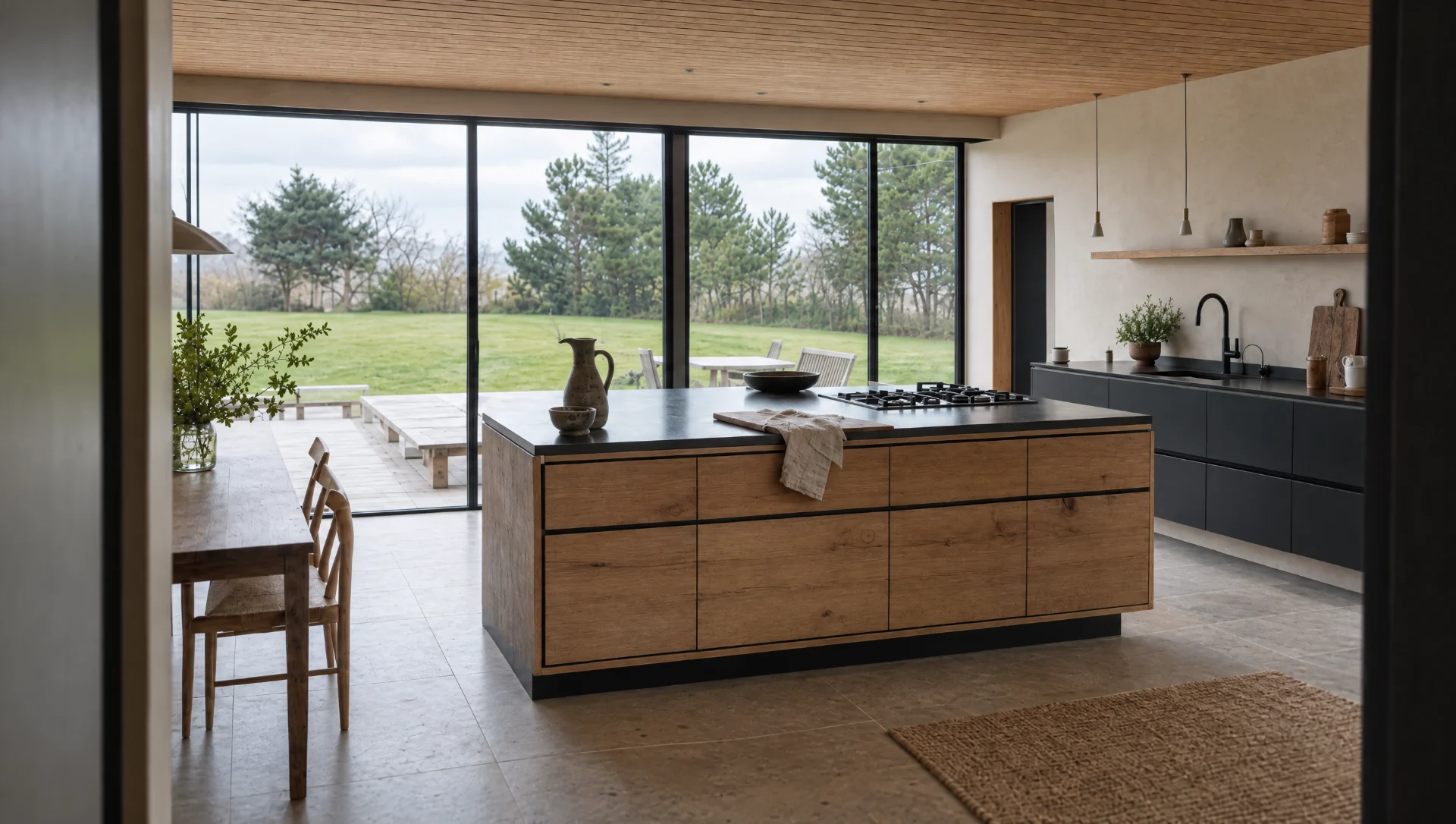
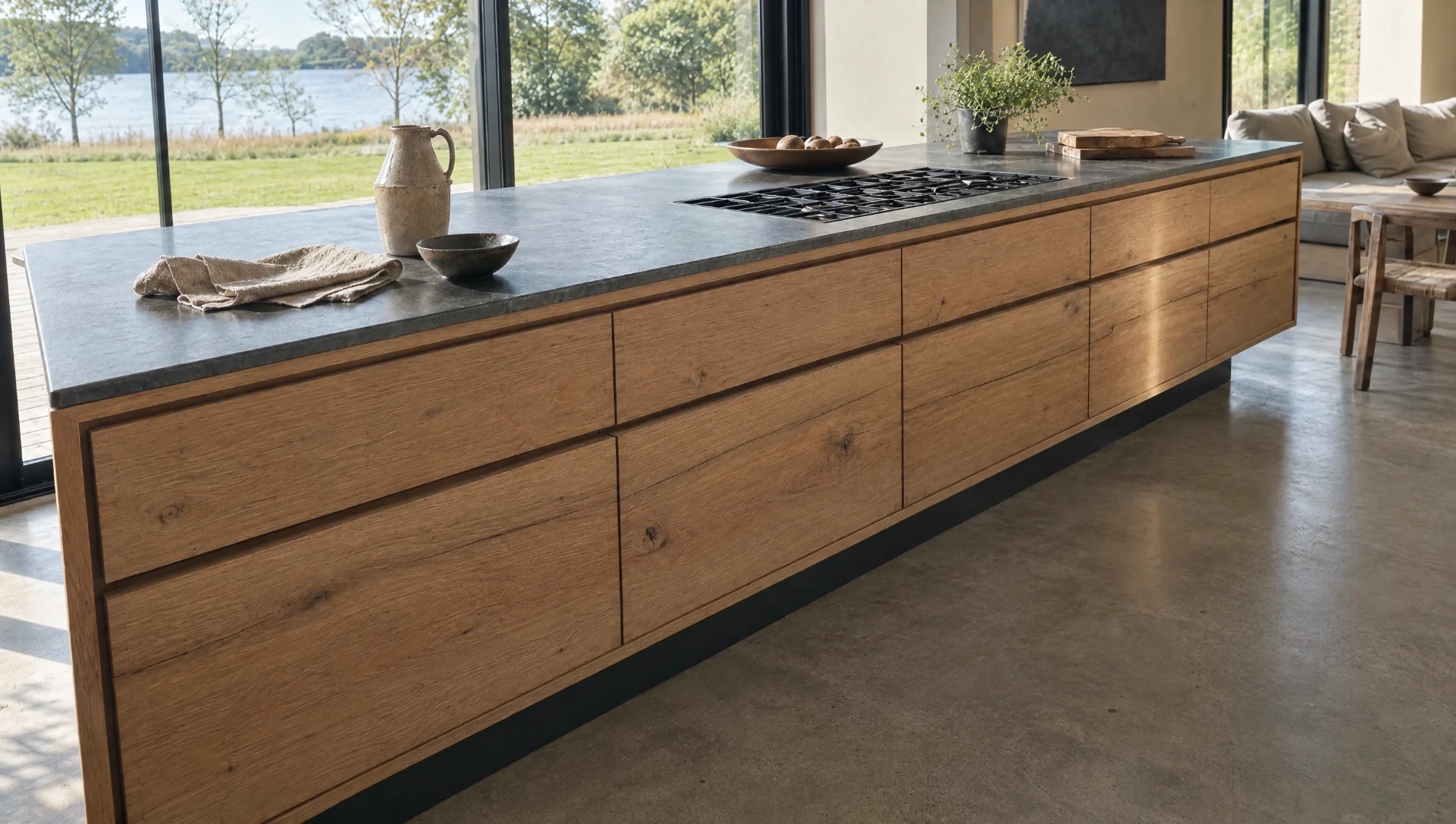
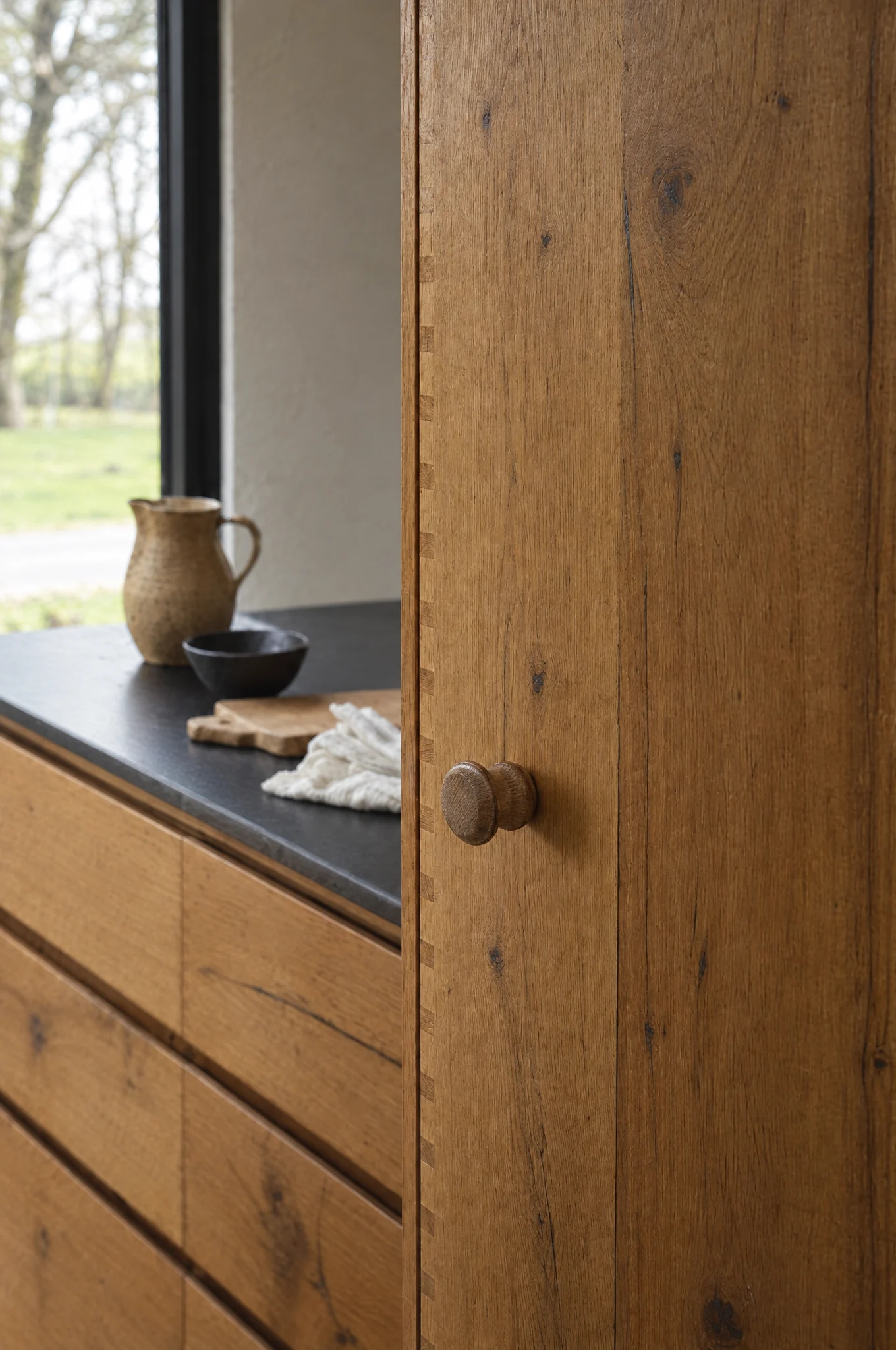
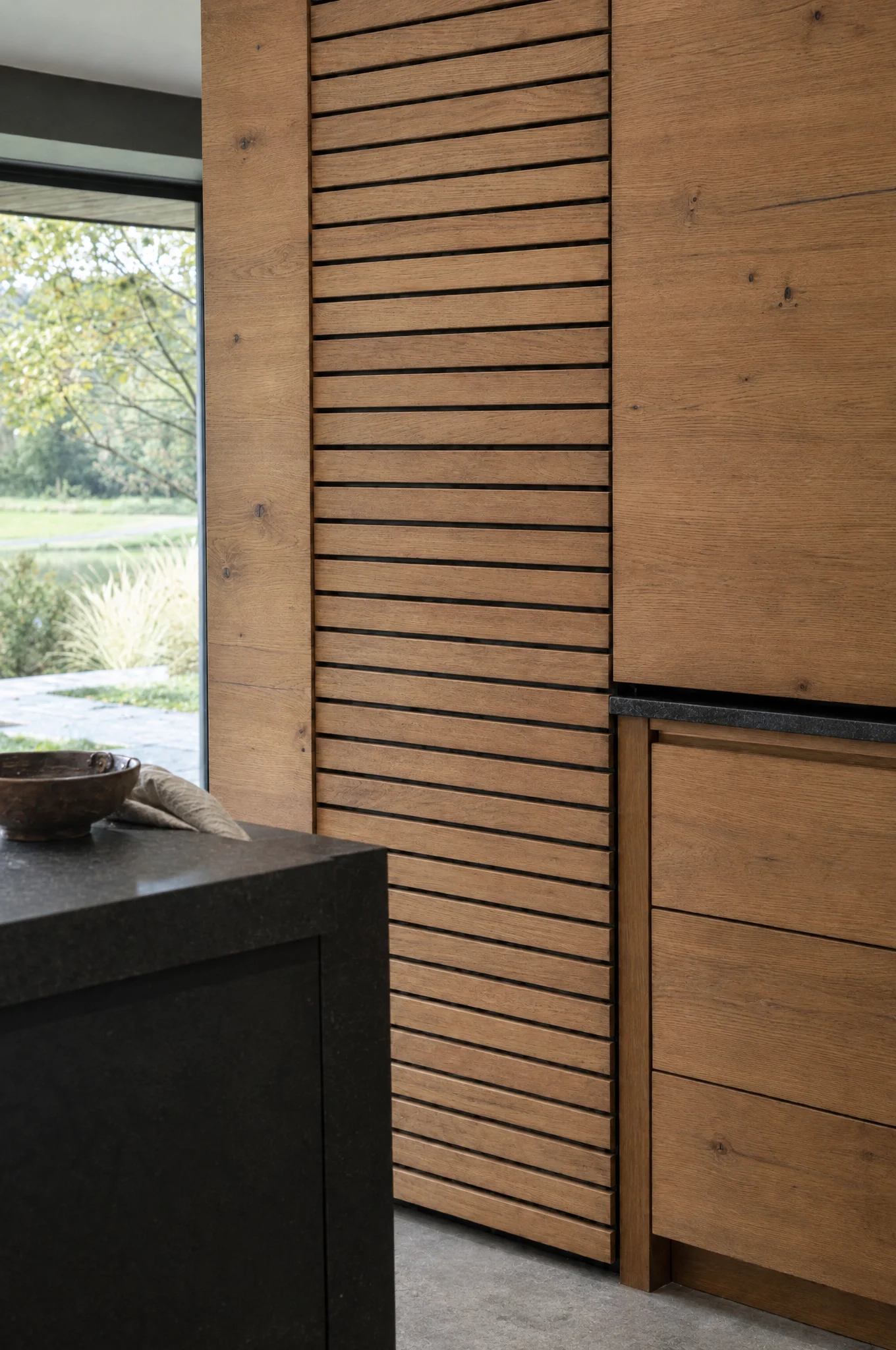
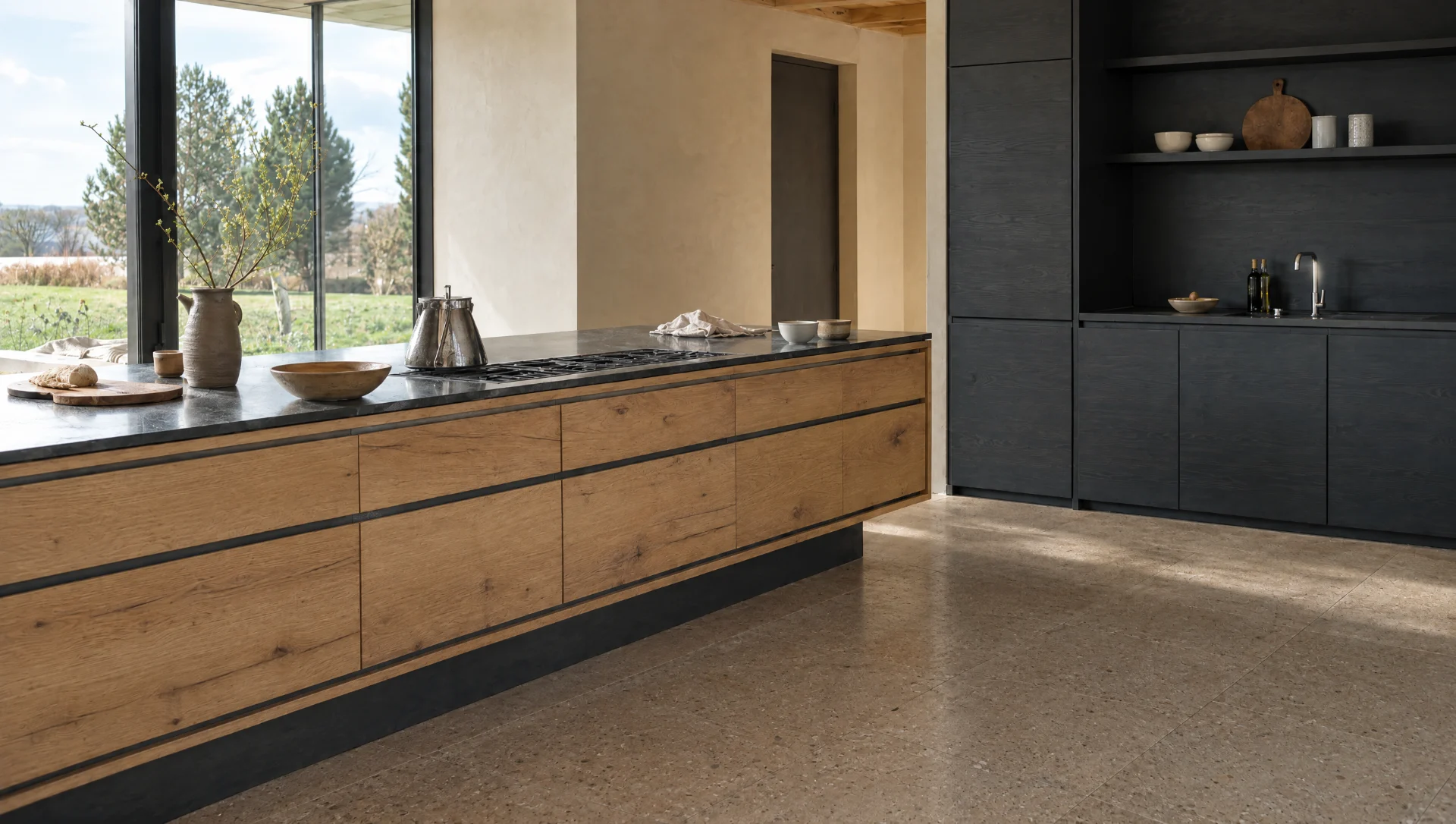
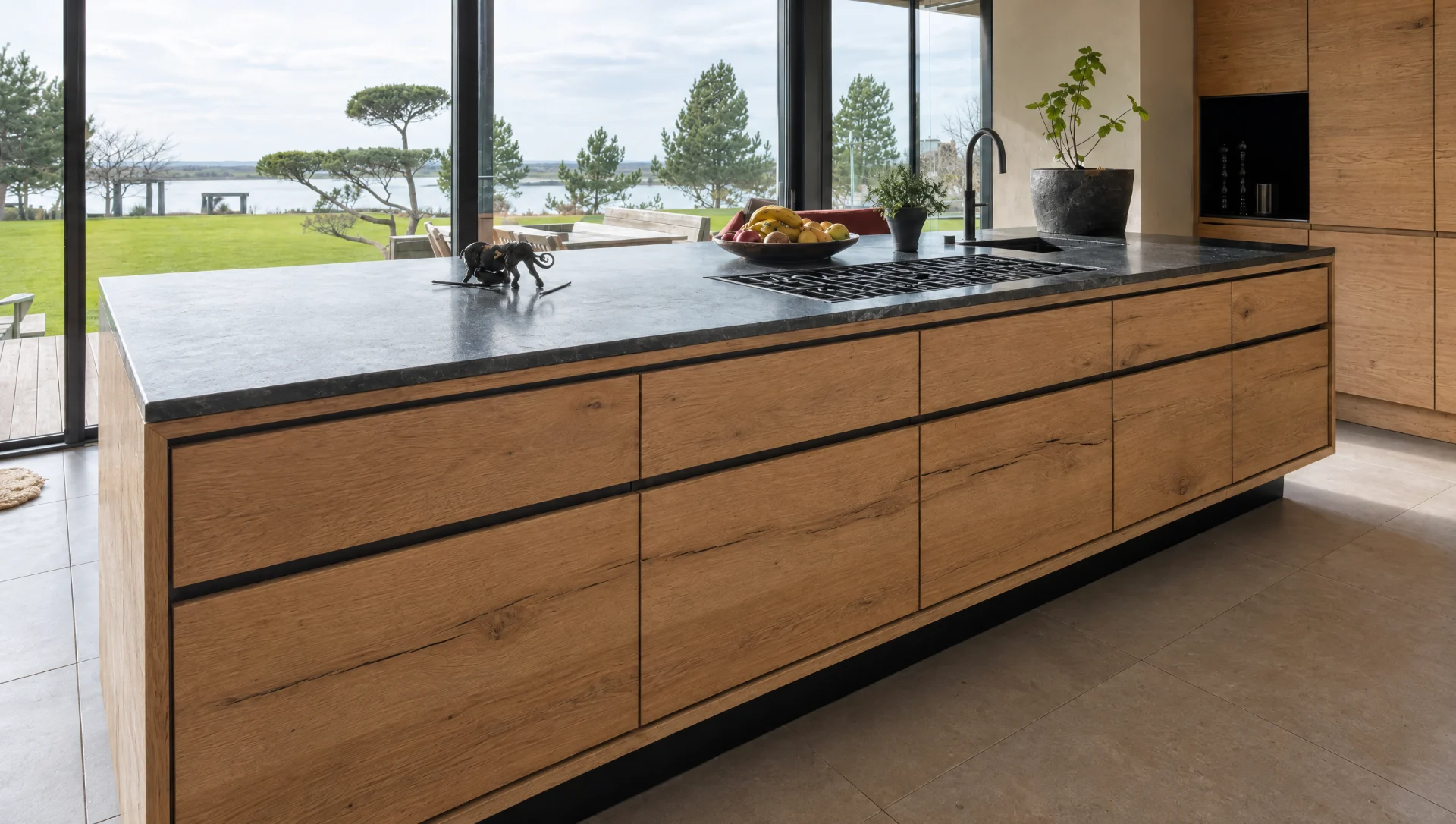
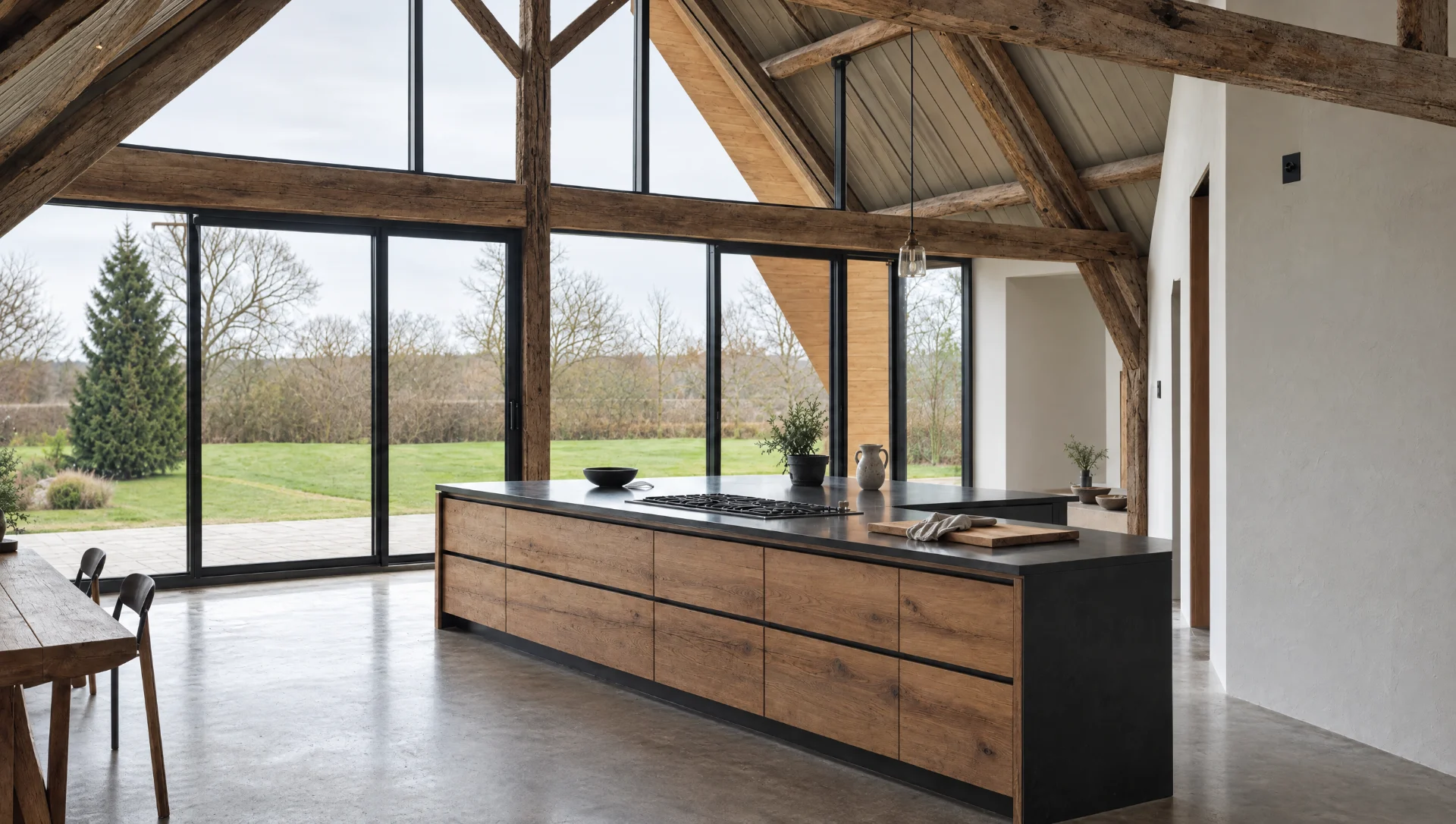
The Scandi is our handleless oak kitchen, in solid timber. Flat and finger-jointed fronts, no paint, no applied handle, no frame around the door. The timber is the finish and the joint is the detail. It is not a veneered handle-less kitchen; that is The Kensington. These are solid timber fronts, engineered in the core so they stay flat, with the grain run through a bank of drawers off one board so the figure carries across the fronts instead of restarting at each gap.
The finger joint
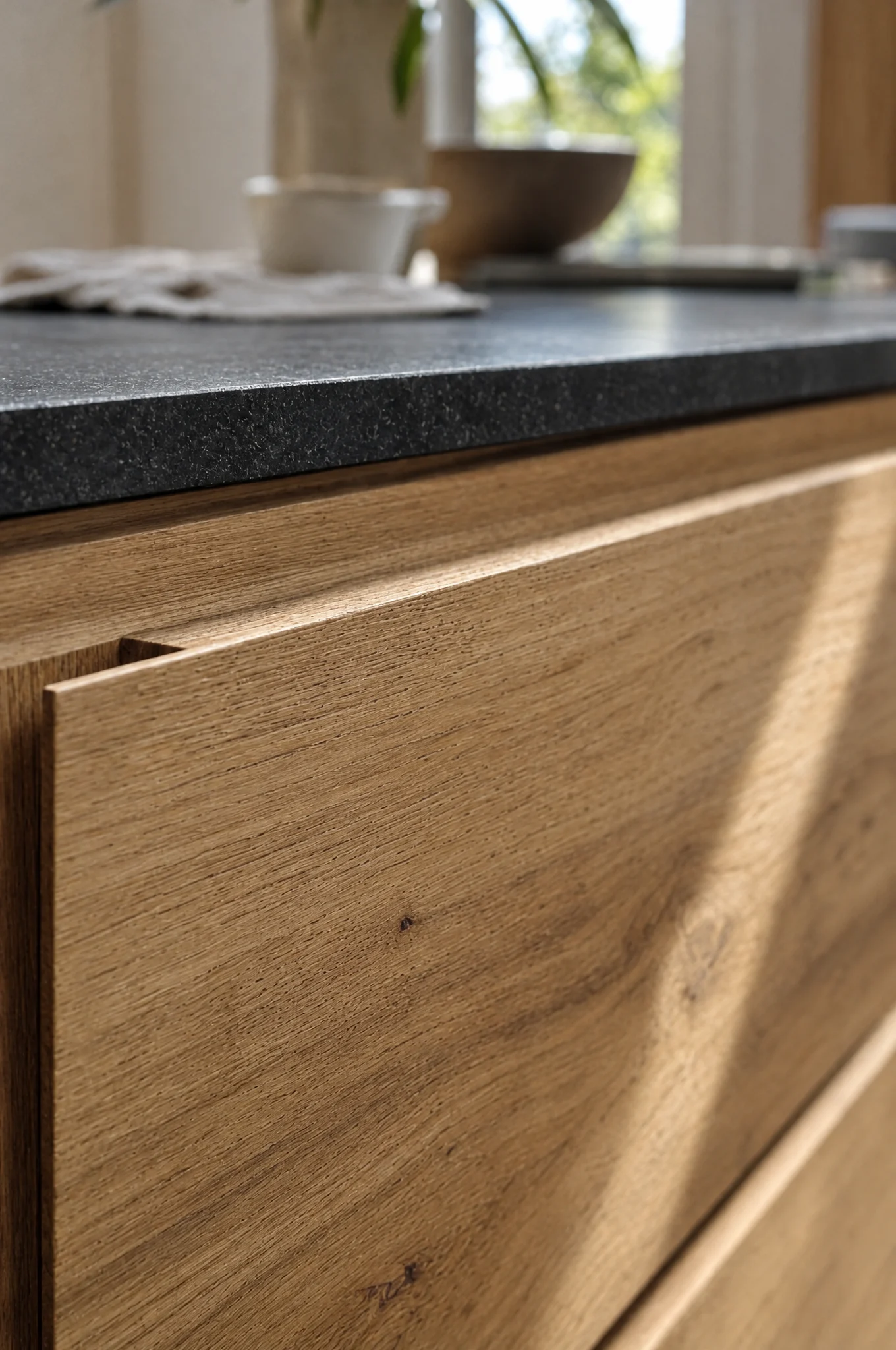
A finger-jointed front has a groove machined along the top edge, deep enough for a hand and shaped so the edge is comfortable to pull. We cut it in the solid, so the profile is continuous timber rather than a lipping glued on. Where a room wants a cleaner face we use a rail behind the top drawer instead, or push-open on tall units. Handle-less only works if the gaps are right. Reveals are 3mm and consistent, and hinge positions, drawer alignment and door heights are set in SolidWorks before machining, then checked against a 1:1 rod.
Timber
European oak, including quarter-sawn for the tight medullary figure, fumed for a brown that goes right through the board, and limed for an open grey. Ash, cherry, elm, sycamore, eucalyptus and smoked larch where the room wants something other than oak. Boards for one kitchen come from a single parcel and are laid out on the bench and numbered before cutting, so colour and figure run in a considered order across the room rather than jumping from door to door.
Finish
Hard-wax oil as standard. It sits in the timber rather than on it, so the surface feels like wood and a mark can be sanded and re-oiled in place. Washed finishes where you want to hold the pale colour of fresh oak against the ambering. Clear or sprayed lacquer where a household needs more resistance than oil gives. All of it applied in our own spray department by our polisher, a trained French polisher who will tell you which of the three your house actually wants.
Hardware and worktops
Blum runners and hinges, Häfele mechanisms, soft close throughout, push-open where there is no pull. Where a handle is used it is small and quiet: leather, black-oxidised steel, brushed steel, a turned timber knob on a larder. For worktops, honed limestone, slate, brushed granite and Belgian Black sit well against oiled timber; Dekton and the quartzes where a family needs the surface to be indestructible; solid oak, iroko or end-grain block on an island. We template, transport, fit and seal with our own people.
Where it belongs
Extensions with a lot of glass. Barn conversions. Coastal houses. Modern houses where a painted in-frame kitchen would look like fancy dress. It carries daylight well, and it looks best in a room with a stone or poured floor and very little else going on, where the grain is the only pattern in the space.
What The Scandi is not good for
Oak does not stay the colour it is on the day we fit it. Fresh European oak ambers over the first two years, fumed oak lightens where the sun reaches it, and anything standing permanently on a timber top will leave its outline behind. If you need the room to look identical in year five to the photographs you approved, take a sprayed finish. Nor does this range give you colour. There is no RAL match, no going darker later, no repaint in six years when the room changes around it. And an oiled top by a sink wants re-oiling every year or two. That is ten minutes with a cloth, but somebody has to remember to do it.
If you like unpainted timber but want colour somewhere in the room, The Norfolk sets painted in-frame cabinetry against oak that is left alone, and puts stone on the island rather than oil on everything.
Our clients’ kitchens are private, and most ask that they are not photographed or published. The images and walkthrough films here are visualisations rather than photographs of a client’s house, built from our own workshop drawings and our own photographs of the work on site and finished with AI. None of it is stock imagery and none of it is somebody else’s work. If you would like to see drawings, samples and references for completed work, we will show you in person — visits to the Mickfield workshop are by appointment.
Specification
| Door style | Flat slab or finger-jointed handle-less fronts. Machined in the solid, no applied lipping. Rail or push-open where a groove is not wanted. |
|---|---|
| Frame | Frameless. 3mm reveals held across the run, set in SolidWorks and checked against a 1:1 rod. |
| Carcass | High-grade birch ply, solid backs. Timber-faced interiors to open runs and larders. |
| Drawer box | Dovetailed solid timber, Blum runners, soft close, push-open where handle-less. |
| Timbers | European oak, quarter-sawn, fumed or limed; ash, cherry, elm, sycamore, eucalyptus, smoked larch. One parcel per kitchen, laid out before cutting. |
| Finish | Hard-wax oil as standard. Washed finishes, clear lacquer or sprayed lacquer. Applied in our own spray booth. |
| Hardware | Blum and Häfele throughout. Leather pulls, black-oxidised steel, brushed steel, turned timber knobs where a handle is used. |
| Worktops | Honed limestone, slate, brushed granite, Belgian Black; Dekton, Silestone, Caesarstone, Sensa; solid oak, walnut, iroko and end-grain block. |
| Lead time | 14–20 weeks from brief to installation. Three to seven days on site. |
| From price | From £35,000. Design fee £500, credited in full against the order. |
The name
Named for what it borrows — Scandinavian restraint — and made the English way, in solid timber rather than veneered board.
Questions
Will the oak change colour?
Yes, and it is worth knowing how before you choose. Fresh European oak ambers noticeably in the first two years and then slows down. Fumed oak is coloured through the board by ammonia rather than stained, so it does not wear pale at the edges, but strong sunlight will lift it. Limed and washed finishes hold their paleness longest. Anything left standing in one place on a timber top for a year will leave a mark behind. If that idea bothers you, choose a sprayed range instead.
Does handle-less really work in a family kitchen?
It works if the grooves are cut properly and the gaps are right, which is most of what we do on this range. A finger joint machined in the solid takes wet hands and hard pulling in a way that a glued-on aluminium profile does not. Two honest points. The top edge of a groove picks up more marks than a handle would, and on oiled oak that shows as a slightly darker line until it is cleaned and re-oiled. And push-open catches on a heavily used bin drawer will wear before anything else in the kitchen.
Is a solid oak worktop practical next to a sink?
It can be, but it is the one place we sometimes talk people out of it. Timber around an undermounted sink needs the cut-out sealed properly on all faces, and it needs standing water wiped rather than left. If that is not how your household runs, put stone on the sink run and timber on the island. We detail the join and the overhang on the drawing so the change of material looks deliberate. Mixed runs are normal here, and they usually work better than one material everywhere.
Can we mix oak with painted cabinets?
Often, yes. A common arrangement is oiled oak on the island and the tall run with painted cabinets along the working wall, or the reverse where the room is dark and needs lifting. What we avoid is a fifty-fifty split, which tends to look undecided. Pick which material leads and let the other one support it. The construction underneath is identical either way, so mixing costs no more than choosing one, and we finish both here in the same shop so the sheens agree.
What does a Scandi kitchen cost?
From £35,000. What moves the number is the timber, the size of the room, the worktop, the hardware and how much of the rest of the house we are making at the same time. Quarter-sawn and fumed oak cost more than plain-sawn, because the yield off a board is lower. The design fee is £500 and it comes off the price in full when you order. You get a fixed quote before any timber is cut. Changes made before manufacture cost nothing, so we would rather you changed your mind at the drawing stage; changes after machining cost money, and we tell you the figure first.
How long does a handleless oak kitchen take?
Fourteen to twenty weeks from brief to installation, and three to seven days on site. The long part is not the machining. It is the drawing and the timber selection: boards for one kitchen come from a single parcel, are laid out on the bench and numbered before cutting, and hinge positions, drawer alignment and door heights are set in SolidWorks and checked against a full-size rod before anything is cut. Oil needs time to cure between coats. Stone is templated after the cabinets are in, which adds time at the end.
How is The Scandi different from The Kensington?
Both are handleless and both are modern. The Scandi is solid timber: the fronts are wood right through, the finger pull is machined in the solid, and the finish is oil that sits in the timber. The Kensington is veneer on a ply core, sprayed or polished, and it can do things solid cannot — one log, sliced and sequenced across eight metres so the figure mirrors and continues. Solid forgives a dropped pan and can be sanded back; veneer cannot. Veneer holds a grain sequence across a whole room; solid cannot. Pick the one whose weakness you can live with.
What is a finger-jointed front, exactly?
A groove machined along the top edge of the door or drawer, deep enough to get a hand into and shaped so the edge is comfortable to pull rather than sharp. We cut it in the solid, so the profile is continuous timber and the end grain is dealt with properly, rather than a lipping glued on that will eventually show a line. Where a room wants a cleaner face we use a rail set behind the top drawer instead, or push-open on tall units. All three can be mixed in one room; we draw it so the logic is consistent rather than random.
Why does the grain run across the drawers?
Because a bank of drawers cut from one board reads as a single object, and a bank cut from four boards reads as four doors that happen to be next to each other. We cut a drawer stack off one board in sequence so the figure carries across the gaps instead of restarting at each one. The same thinking runs across a whole elevation: boards are laid out on the bench and numbered before cutting so colour and figure move in a considered order through the room. It costs more in timber because the yield is lower. It is the whole point of the range.
What finish do you use, and can we change it later?
Hard-wax oil as standard. It sits in the timber rather than on it, so the surface feels like wood, and a mark can be sanded and re-oiled in place without taking the door off. Washed finishes hold the pale colour of fresh oak against the ambering. Clear or sprayed lacquer where a household needs more resistance than oil gives. Oil can be refreshed or built up at any point, and oiled work can be lacquered later if the household changes. Going the other way — lacquer back to oil — means stripping, so it is worth deciding properly at the drawing stage.
What guarantee comes with a Scandi kitchen?
Ten years on our cabinetmaking, joinery and installation. If a joint opens, a front cups or a carcase fails, we come and put it right. There is a six-month visit to adjust doors and drawers once the house has settled around the kitchen, which matters more on a handleless kitchen than on any other range because the gaps are the design. We keep parts for life, so a hinge or a runner can be replaced years later. Normal colour change in timber is not a defect and is not covered — it is what oak does, and we say so before you order.
Can we have push-open instead of a finger pull?
Yes, and on tall units it is often the better answer, because a finger groove at eye level is a dust trap and reads as a line across the elevation. We use push-open and servo hardware from Blum and Häfele. The one place we will argue is the bin drawer and the everyday cutlery drawer, where push-open with wet or full hands is a daily irritation that no photograph ever shows. Our usual arrangement is finger pulls on the working run, push-open on the tall bank, and a small quiet handle where a door is heavy.
What happens if a front gets scratched or dented?
On an oiled solid timber front, most of it comes out. A scratch is sanded locally and re-oiled, usually in place and usually within the hour; a dent in oak can often be raised with a damp cloth and a hot iron before any sanding at all. This is the practical advantage of solid over veneer, and of oil over lacquer. A deep gouge across a finger pull is a new front, and because we keep the timber records for a kitchen we can go back to the same parcel where any of it remains, though an exact figure match years later cannot be promised.
Which worktops suit solid oak fronts?
Honed limestone, slate, brushed granite and Belgian Black all sit well against oiled timber, because a matt or textured stone answers an oiled surface better than a polished one. Dekton and the quartzes where a family needs the surface to be indestructible. Solid oak, iroko or end-grain block on an island, where people sit rather than work. The one combination we tend to talk clients out of is a high-gloss engineered white against oiled oak: the timber makes the stone look plastic and the stone makes the timber look orange.
Can we extend the kitchen in a few years and have it match?
Better than in any other handleless range, but not perfectly. Solid oak can be matched for species, cut and finish, and we keep the specification for every kitchen we make. What cannot be matched is age: five-year-old European oak has ambered and new stock has not, so a new run will be lighter for a year or two before it catches up. It does catch up. If you know an extension is coming, tell us and we will buy the timber for both phases in one parcel and store the balance here.
Do you fit it yourselves?
Yes. Our own team templates, transports, fits and seals. Three to seven days on site. Handleless is a tolerance problem before it is a design decision — a 3mm shadow gap will report a wall that is 6mm out over three metres and a floor that falls away under an island — so the fitting is where this range is made or lost. We survey and model the room in 3D before machining, and scribe on site. We do not hand the boxes to a third-party fitter, because the reveals we spend the drawing on cannot survive that.
Is oak the only timber?
No. European oak is the default, including quarter-sawn for the tight medullary figure, fumed for a brown that goes right through the board rather than sitting on the surface, and limed for an open grey. Beyond that we work in ash, cherry, elm, sycamore, eucalyptus and smoked larch. The choice is usually settled by the room rather than the sample: a north-facing room with a lot of glass takes a warmer timber than the photographs suggest, and a very pale floor will make fumed oak read almost black. We bring boards to the house rather than swatches.
Start a conversation
Tell us about the room, the house and roughly when you would like to be cooking in it. We will tell you honestly whether we are the right people for it.
Make an enquiry