Hand-painted or sprayed
Our finisher on the two systems: what four brushed coats do that a sprayed film cannot, what a sprayed film does that no brush will, and which one you can repair in your own kitchen.
Two different things, not two grades of the same thing
People arrive assuming sprayed is the modern, better, more expensive option and hand-painted is the traditional, softer, cheaper one. Neither half of that is reliably true. They cost within about 15 per cent of each other on most kitchens, and which is better depends entirely on the door in front of me.
A brushed finish is a film laid on in thin passes with a bristle, following the shape of the timber. A sprayed finish is an atomised film laid on evenly by air, sitting across the shape of the timber. On a moulded door, the brush follows the moulding and the light does the rest. On a wide flat door, the brush leaves a texture and the spray does not.
So: The Essex and The Suffolk are hand-painted. The Kensington is sprayed. That is not a marketing decision, it is what each door wants.
What four coats actually involves
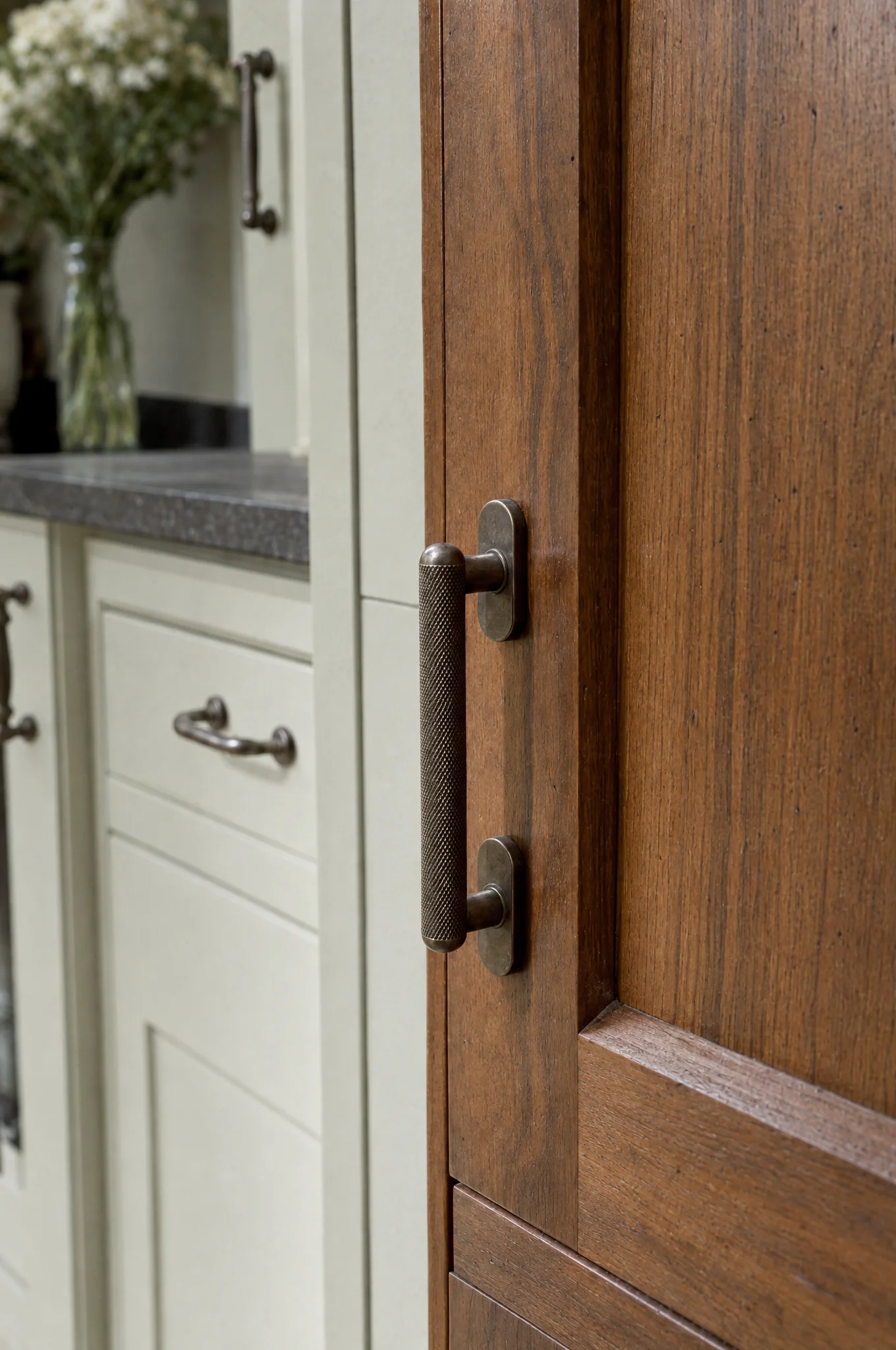
A hand-painted door comes to me from the bench sanded to 150 grit. I take it to 180, then 240 on the faces, and I break every arris with a fine block — a sharp edge holds no paint and it is the first place a kitchen chips.
Knots and any resinous streak get a shellac barrier. On oak, everything gets shellac, because tannin will come through a water-based primer as a brown ghost within a fortnight.
Two coats of primer. The first is thinned slightly and worked in; it raises the grain, which is the point. When it is dry I denib the whole door with 320 grit on a cork block, which takes off the raised fibres and any dust that has landed. The second primer coat goes on fuller and is flatted again, this time to a surface where you can run the back of your hand over it and feel nothing.
Two topcoats. Each is laid off in one direction — stiles with the grain, rails with the grain, panel last — and each takes about eight minutes a door if I am not interrupted. Overnight between coats. In practice a kitchen’s worth of doors moves through the room in batches, and a whole kitchen occupies the finishing room for two and a half to three weeks.
The room sits at about 20°C with the humidity held in the middle range. Paint applied cold stays open too long and sags; paint applied in a dry draught skins before it flows out and keeps every brush mark.
What spraying involves, and where it is harder
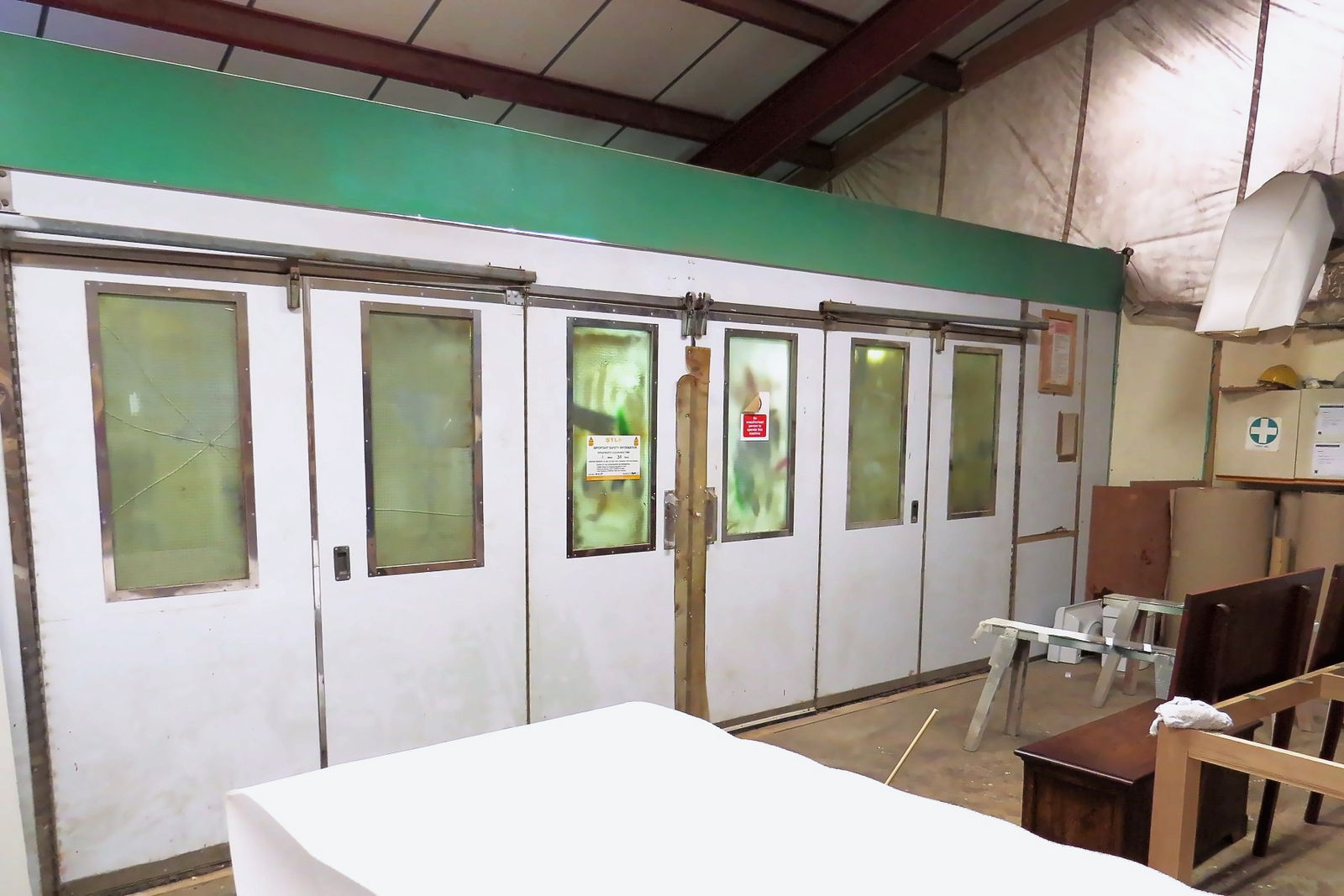
Sprayed work in our shop is a two-pack system: a catalysed primer, flatted, then two topcoats at 30 to 35 microns dry film each. It goes off chemically rather than by evaporation, so it is touch-dry in an hour, handleable the next day and at full hardness after about seven days. Do not scrub a sprayed kitchen in its first week.
The film is harder than any brushed paint, more resistant to solvents and to household chemicals, and dead flat with no texture at all.
The difficulty is that flatness. A sprayed surface is a mirror for the shape beneath it: every undulation, every proud joint, every place where the veneer has telegraphed a core seam shows up under raking light. The preparation therefore has to be better than for a brushed door, not worse. That is why the two systems cost similar money.
The other difficulty is dust. Every nib in the air lands in the wet film, and a nib in a two-pack topcoat is not something you flick off — it has to be cut back with 1,500 grit and polished. The booth is cleaned before every session and the doors go in still slightly damp with tack rag.
Colour behaves differently in each
Two things surprise clients. The first is that a colour looks different brushed and sprayed. A brushed film scatters light very slightly because of the texture, so colours read a shade warmer and softer. Sprayed, the same colour reads cleaner and colder. Deep greens and blues show this most.
The second is opacity. Some pigments simply do not cover. Deep reds, bright yellows and certain strong blues can need a third topcoat, and a couple need a tinted primer underneath. This is a cost, and we say so at quotation rather than at invoice.
Nobody should choose a colour from a card. A card is printed ink on paper. I make sample boards on the actual timber, in the actual system, and I make them A4 or bigger, because a colour on a small chip always reads lighter than the same colour on a door. Then look at it in the room, on the wall it will face, in the morning and at nine at night with the lights on. Clients change their mind at that stage often enough that it is the whole point of doing it.
Repair, which is the real difference
This is what I would want to know if I were commissioning.
A hand-painted kitchen can be repaired in your kitchen. A chip on a door edge is filled, feathered with 320, and brushed with the same paint from the same tin — we leave you a litre of each colour, labelled with the batch and the sheen. In ten years, when the doors near the bin have had enough, they come off, get flatted, get two fresh coats, and go back on. That is two days’ work and the kitchen is new again.
A sprayed two-pack finish cannot be touched in with a brush. A brushed repair on a sprayed door is instantly visible because the texture is different. A proper repair means the door comes off, comes back to the workshop, and is flatted and re-sprayed as a whole face — a fortnight and a few hundred pounds, and it will be perfect.
So: if your kitchen is going to be used hard by children, dogs and people who put hot pans down without thinking, hand-painted will age better because it can be maintained by hand. If you want a surface that stays absolutely flat and even for twenty years and you are prepared to send a door back on the rare occasion something happens to it, sprayed is the better film.
There is no third option where you get both. Anyone who tells you otherwise has not had to repair one.
Start a conversation
Tell us about the room, the house and roughly when you would like to be cooking in it. We will tell you honestly whether we are the right people for it.
Make an enquiry