
Construction
Carcass — the box. Everything else hangs off it. Ours are 18mm birch-faced plywood with the backs housed into a groove rather than pinned on the outside, which is what stops a cabinet racking.
Face frame — a solid timber frame fixed to the front of the carcass, into which the doors sit. Mortice-and-tenoned at the corners on good work, pocket-screwed on cheaper work.
In-frame — the door sits inside the face frame, flush with it. Slower, more expensive, and unforgiving: the reveal shows every error.
Lay-on (or overlay) — the door sits on the front of the carcass, covering it. Almost every fitted kitchen in Britain is lay-on. It is much easier to make and to fit.
Reveal — the gap around a door. Three millimetres is the usual target on in-frame work. It has to be identical on all four sides and on every door in the run, which is the whole difficulty.
Scribe — cutting a component to follow the exact shape of a wall or floor that is not straight. The difference between joinery that looks built in and joinery that looks delivered.
Plinth — the recessed board at the bottom of a run, between the cabinet and the floor. Scribed to the floor individually where the floor moves.
Rod — a full-size setting-out of the job on sheet material, pinned above the bench, from which the parts are marked and machined. A nineteenth-century habit and still the most reliable one.
Doors and ornament
Shaker — a five-piece door with a flat recessed centre panel and no moulding. The most-asked-for door in Britain and, done properly, the hardest to hide anything behind.
Cock bead — a small half-round bead standing proud of the frame around a door or drawer. A period detail that adds a shadow line.
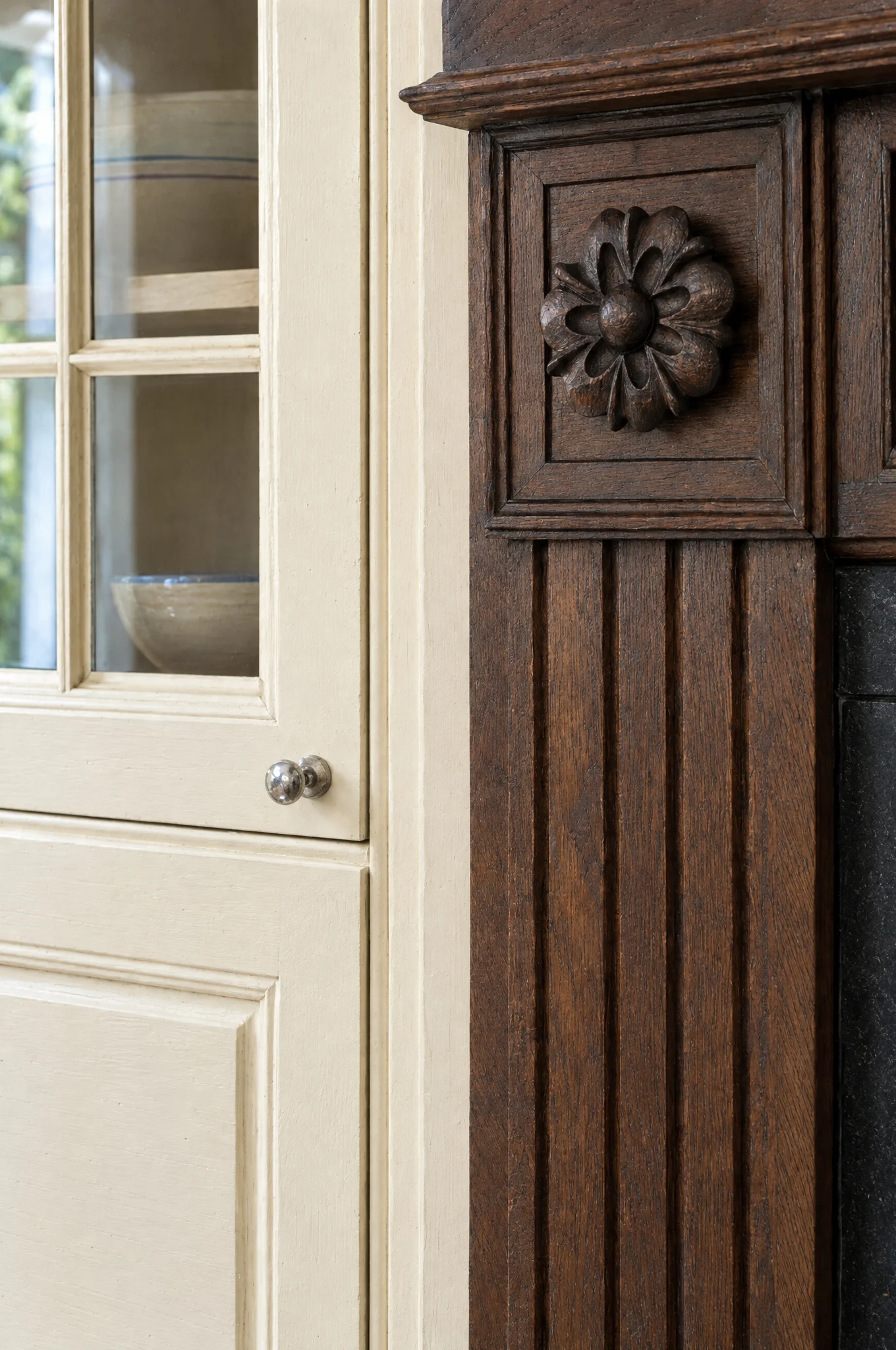
Bolection — a moulding that stands proud of the face it is applied to, rather than sitting within it. Usually found around a panel or a fireplace.
Ovolo, ogee, astragal — moulding profiles. An ovolo is a quarter-round; an ogee is an S-curve; an astragal is the small moulded bar dividing the panes in a glazed door.
Fielded panel — a panel with its edges chamfered back so the centre stands proud. Georgian and Victorian joinery is full of them.
V-groove — boards with a chamfered edge so the joint reads as a V. A farmhouse detail.
Fluting — parallel concave grooves cut into a surface, usually vertical. On a pilaster or an island end.
Cornice and pelmet — the moulding at the top of a run of tall or wall units, and the one at the bottom. The cornice is what ties the joinery to the room.
Drawers, doors and hardware
Dovetail — an interlocking joint used at the corners of a drawer box. Through-dovetails show on both faces; lapped dovetails show on one. Hand-cut is slower and better looking; machine-cut is perfectly strong.
Soft close — a damper that stops a drawer or door slamming. Universal now, and worth having.
Full extension — the drawer comes all the way out, so you can reach the back. Anything less and you lose the last 150mm of every drawer.
Butt hinge — a traditional two-leaf hinge let into the edge of the door and the frame. Used on in-frame work. Adjustable only by re-cutting, which is why the setting-out has to be right.
Concealed hinge — the sprung cup hinge used in almost all fitted kitchens. Adjustable in three directions, invisible when closed.
Unlacquered brass — brass with no protective coating. It starts bright, goes dull, then dark, then interesting. If you want it to stay bright you want lacquered, and it will chip.
Finishes
Hand-brushed — paint applied with a brush, usually four coats. Leaves a faint texture that catches light and is easy to repair invisibly later.
Sprayed — paint applied in a booth. Flatter and more uniform. Harder to touch in on site.
Two-pack — a paint that cures by chemical reaction rather than by drying. Harder and more durable than a conventional finish, and it cannot be touched in with a brush afterwards.
Hard-wax oil — an oil finish for timber that sits in the surface rather than on it. Repairable by sanding and re-oiling a patch, which lacquer is not.
French polish — shellac applied in many thin layers with a rubber. A furniture finish, occasionally used on a kitchen dresser or a library.
Knotting and priming — sealing the knots so resin cannot bleed through the paint, then priming. Skipped on cheap work, and it shows within two years as brown patches.
Timber
Tulipwood — Liriodendron tulipifera, called poplar in the United States. Stable, fine-grained and takes paint without the grain telegraphing through. The standard timber for painted work in this country.
Character grade — timber selected to include knots and figure, rather than to exclude them. Cheaper to buy and much harder to use well, because every board has to be laid out deliberately.
Book-matched — consecutive leaves of veneer opened out like the pages of a book so the figure mirrors across a centre line.
Sequence-matched — veneer leaves kept in the order they were sliced and laid up in that order across a whole job, so a run of doors reads as one piece of timber.
Quarter-sawn — boards cut radially from the log. More stable than plain-sawn and, in oak, shows the medullary ray as flecks.
Moisture content — how much water is in the timber, as a percentage. Interior joinery wants eight to ten per cent. Timber at the wrong moisture content will move after it is installed.
Rooms
Scullery — the working room behind the kitchen. Second sink, dishwasher, bulk storage, and everything that never looks tidy.
Pantry — a cold store for food. What makes it a pantry rather than a cupboard is the temperature: a north wall, a stone or marble shelf, and a vent.
Larder — a full-height food cupboard, usually with shallow shelves to the doors. Often used interchangeably with pantry, though a larder is furniture and a pantry is a room.
Boot room — coats, boots, dogs and laundry. The hardest-worn room in the house and the one most often under-specified.
Start a conversation
Tell us about the room, the house and roughly when you would like to be cooking in it. We will tell you honestly whether we are the right people for it.
Make an enquiry