
Working abroad
Made in Suffolk, installed wherever the house is. Our own fitting team travels, and the crate, the freight and the paperwork are inside one contract.
What travels, and what does not
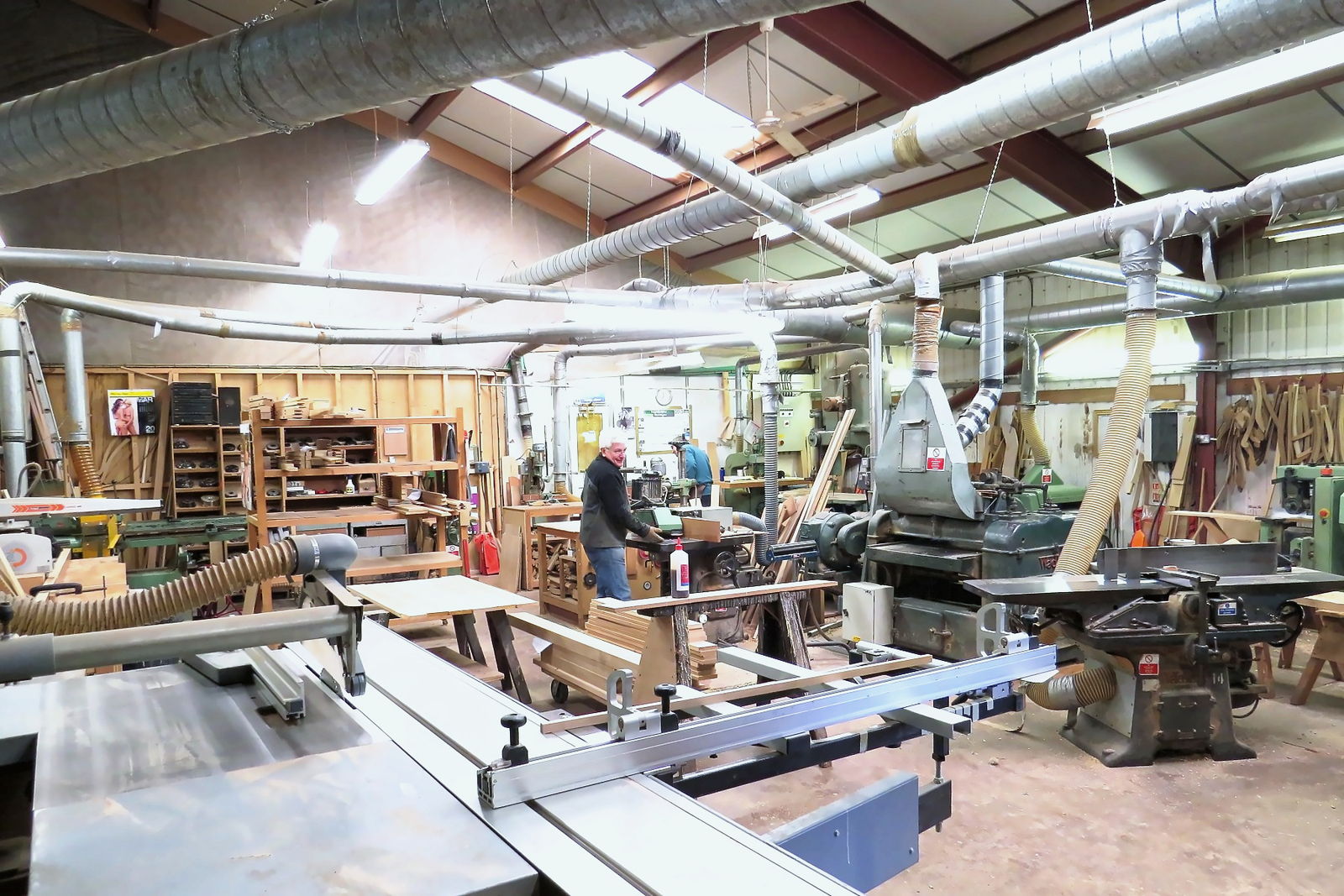
The kitchen is made here. It is drawn here, machined here, assembled here, finished here, and then dry-assembled here so that every joint is proved before anything is packed. Nothing is manufactured abroad under licence and nothing is subcontracted to a factory in the destination country.
What travels is the finished work and the people who made it. Our own fitters install: the team that fits in Chelsea is the team that fits abroad. That is the whole proposition, and it is the reason an English kitchen is worth shipping in the first place. If somebody else assembles it at the far end, you have bought flat-pack with a good accent.
One contract
Export crating, freight, insurance and customs documentation are arranged by us and priced inside the quotation. One contract, one point of responsibility, one number at the bottom of the page.
That matters more than it sounds. The commonest way an overseas joinery project goes wrong is not the joinery — it is a crate sitting in a bonded warehouse because the commodity codes were wrong, while a fitting team stands in an empty room three thousand miles away on day-rate.
Cabinets are crated in purpose-built cases with the timber conditioned before it ships, because a kitchen made at eight to ten per cent moisture content in Suffolk is going somewhere with a different climate, and that has to be designed for rather than discovered.
Where we have worked
Reeve & Co, the original workshop, has delivered joinery to the United States — a residence in Southampton, New York — and to France, for a château in the Loire Valley. It has also made marine joinery for yachts, which is the hardest version of this problem: everything has to be right first time, in a space that moves, with no possibility of a return visit.
That is a short list and we will not dress it up as longer. What it demonstrates is that the crating, the freight, the documentation and the travelling installation are processes this workshop has actually run, rather than ones we would be attempting for the first time on your house.
What is different about an overseas commission
The survey. We come to the house, at our cost within Europe, because a drawing made from somebody else’s dimensions is a drawing made from somebody else’s mistakes.
The programme. Add four to six weeks to a UK lead time for sea freight, less for Europe by road. The manufacture takes exactly as long as it would for a house in Suffolk.
Electrical and plumbing standards. Appliance specifications differ by market and the housings are drawn around the specific appliance, so we need the schedule with model numbers earlier than we would here.
The price of the joinery does not change. What changes is the survey travel, the crating, the freight and the number of nights the fitting team is away — all of it itemised in the quotation rather than added afterwards.
Who this suits
Private houses in Europe and North America where the client wants an English kitchen and means it: in-frame, hand-painted, solid timber, made by the people who fit it.
It suits an architect or a project manager who would rather hold one contract than coordinate a maker in one country and an installer in another. And it suits a client who is not in a hurry, because this is not a fast way to buy a kitchen.
It does not suit anybody who needs it in eight weeks.
Start a conversation
Tell us about the room, the house and roughly when you would like to be cooking in it. We will tell you honestly whether we are the right people for it.
Make an enquiry