
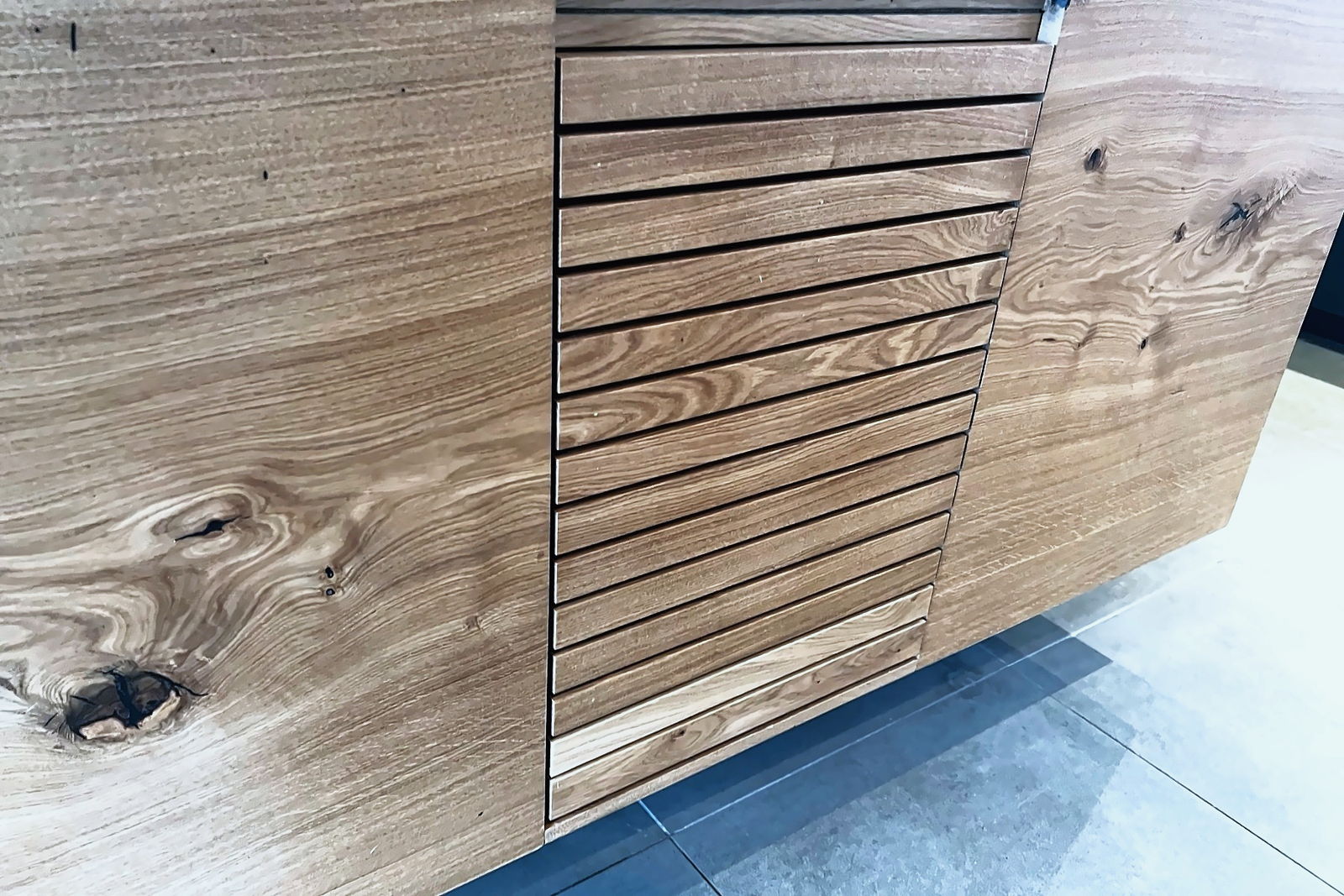
Choosing timber for a painted kitchen
Paint hides colour and grain but it hides nothing about movement. What we use under a painted finish, and what happens when the wrong species is chosen.
What paint asks of a timber
People assume that because paint covers the timber, the timber can be anything. The opposite is nearer the truth. A clear finish forgives movement, because a hairline gap in an oiled oak door looks like oak. Paint does not forgive it, because paint is a continuous film and a continuous film either stays continuous or cracks.
So under paint we want four things: dimensional stability, closed grain, a surface that takes primer without drinking it unevenly, and enough hardness at the edges to survive a saucepan.
There is no species that is best at all six. Everything below is a trade.
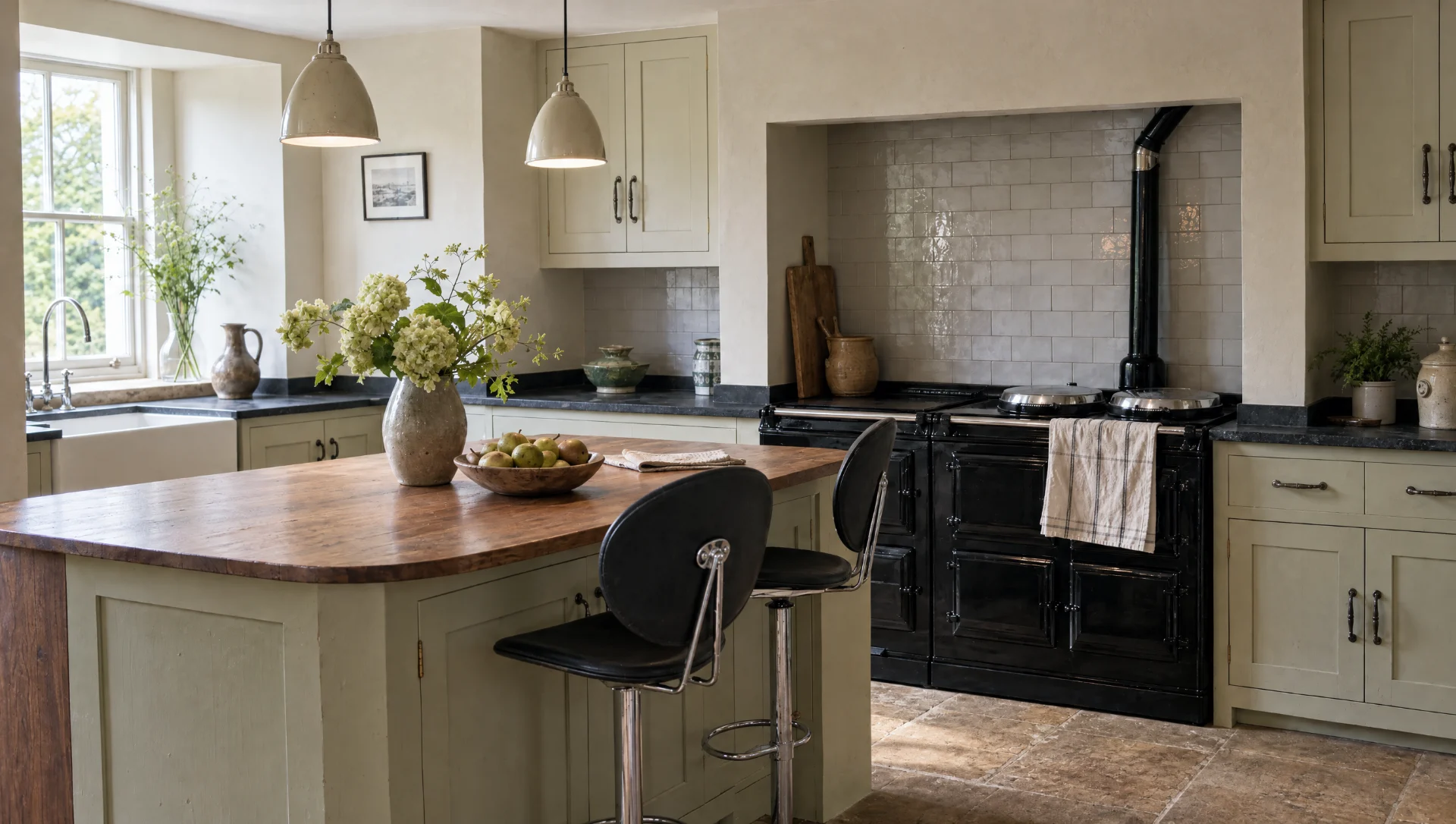
Tulipwood, and why it is the standard
American tulipwood — liriodendron tulipifera, called poplar in the States and yellow poplar in the trade — is what most of our painted work is made from, and it is the standard choice for painted work in this country.
It is around 490 kg per cubic metre at 12 per cent moisture content, so it is light to handle and easy on tooling. The grain is fine and closed, so a primer sits on top of it rather than sinking into open pores. It machines cleanly on the spindle moulder, which matters when you are running a bead on the solid and cannot afford break-out. It is stable once dried, with tangential shrinkage around 8.2 per cent green to oven-dry, and, more usefully, it stays put in service.
Its weakness is hardness. Tulipwood sits at about 2,400 newtons on the Janka scale, roughly half of European oak. It dents. On a door face this does not matter, because the six-coat paint film and normal life do not conspire often. On the leading edge of a pan drawer beside a range cooker it does.
Its other oddity is colour: it comes out of the tree green, purple and brown in streaks. Under paint, irrelevant. It is one of the reasons it is affordable.
Maple, where the section is small
Hard maple is around 700 kg per cubic metre and about 6,400 newtons on the Janka scale, which is to say nearly three times as hard as tulipwood.
We use it wherever a section is small, highly stressed, or going to be handled. Narrow glazing bars in a dresser. Turned legs and columns, because maple turns without tearing and takes a crisp bead off the skew chisel. The leading edges of drawer fronts in a busy family kitchen. Any moulding with a fine arris that would bruise in a softer timber.
It costs roughly 60 to 80 per cent more than tulipwood per cubic metre, it is heavier to work, and it blunts tooling faster. In a kitchen it might be 10 per cent of the timber by volume and worth every penny of the difference.
Oak under paint
Clients ask for it, usually because they want to know the timber underneath is oak. It can be done. It needs to be done properly or not at all.
Oak’s pores are large and open. Paint bridges some of them and sinks into others, so an unfilled oak door under four coats reads as a painted surface with a grain pattern showing through it. Some people want exactly that; it is a handsome, slightly rustic look and it is honest about what is underneath. If you do not want it, the pores must be grain-filled and flatted, which is two extra operations and adds around 25 per cent to the finishing cost.
Oak is also tannin-rich, and tannin will bleed through a water-based primer as a brown stain, particularly where the timber has met an iron cramp or a wet cloth. It needs a shellac-based barrier coat first.
And it moves more: tangential shrinkage around 10.5 per cent against tulipwood’s 8.2. On a wide painted panel that difference is the difference between a paint film that survives and one that shows a hairline at the shoulder after the first winter of central heating.
Walnut we do not paint at all. It is a beautiful, expensive timber and putting four coats of paint over it is a waste of somebody’s tree.
The panel question
The frame of a painted door is always solid timber. The panel is a decision.
A solid timber panel is traditional, and it must float: housed into a groove with a 3mm space at each edge and no glue, held central with a small ball of mastic or a spring so it cannot rattle. A 400mm wide tulipwood panel will move about 1.5mm across the year. If the painter allows paint to bridge from panel to frame — which happens easily, because paint is liquid — the film tears at the shoulder line in January and you get a fine dark line around the panel.
A veneered MDF panel does not move. The paint film stays whole and the door looks the same in July and January. It is what we use in The Kensington as a matter of course and what we recommend for large flat panels in painted work, particularly in houses with underfloor heating, where indoor humidity swings hardest.
There is no dishonesty in this as long as it is said out loud, which is why we say it here. Solid frame, engineered panel, and a paint film that survives. Some clients want solid throughout and accept the line. Both are defensible; only pretending is not.
Moisture content, which decides everything
All our timber arrives kiln-dried to 8 to 10 per cent moisture content. It then sits in the timber store, stickered with 25mm battens between the boards so air moves round every face, for two to three weeks minimum.
We meter it before machining. Anything above 11 per cent goes back on the sticks. This is unglamorous and it is the whole game: a door machined from a board that has not settled will move after it is made, and no amount of care at the bench will save it.
Boards are also machined in stages — rough sawn oversize, left overnight, then thicknessed to final size the next day — because releasing the tension in a board is not instantaneous. A stile that comes off the planer dead straight can have a bow in it by teatime. Better it happens on our bench than in your kitchen.
Start a conversation
Tell us about the room, the house and roughly when you would like to be cooking in it. We will tell you honestly whether we are the right people for it.
Make an enquiry