Paint and finish
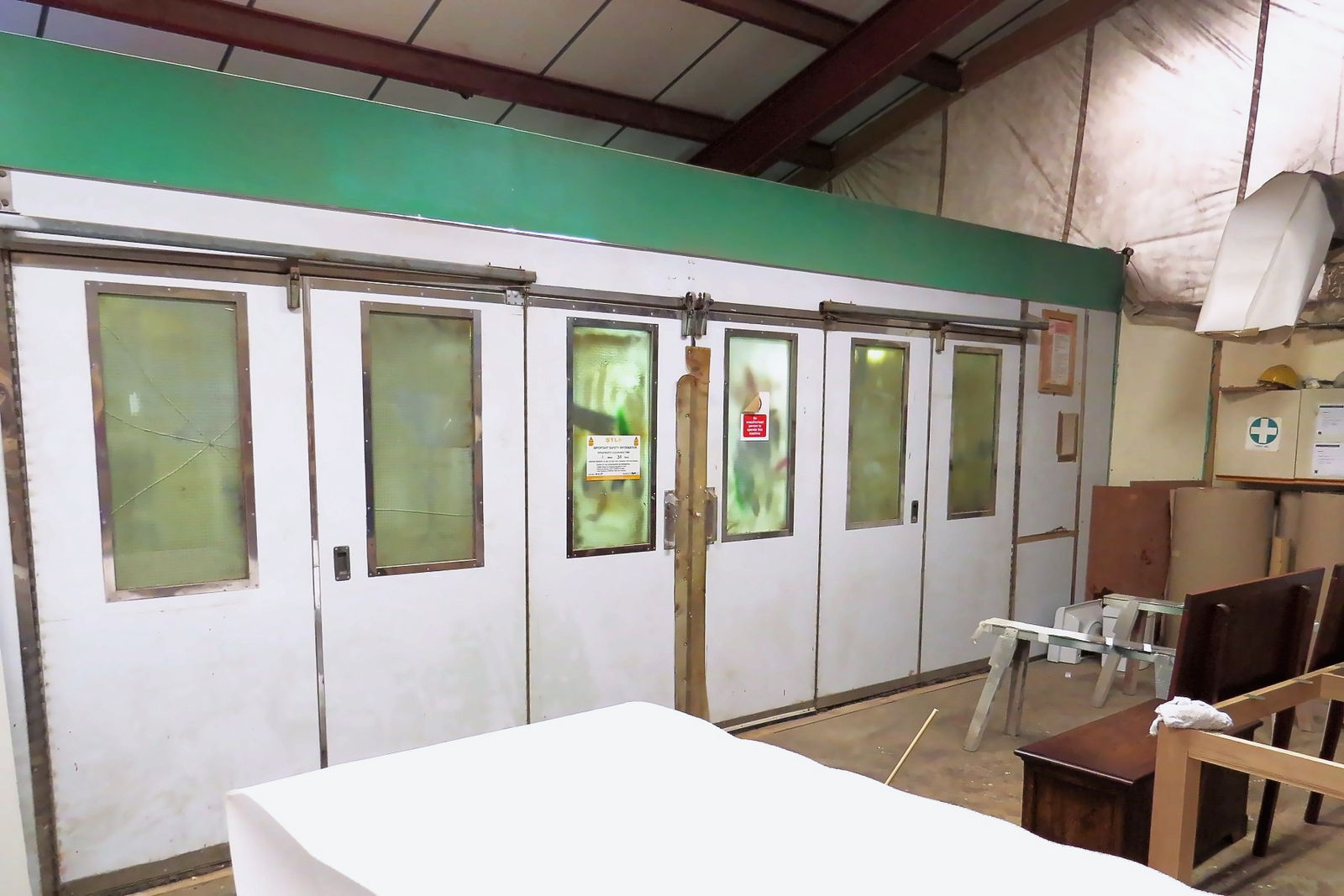
Every surface is finished in our own booth at Mickfield, and nothing is sent out.
Our own booth
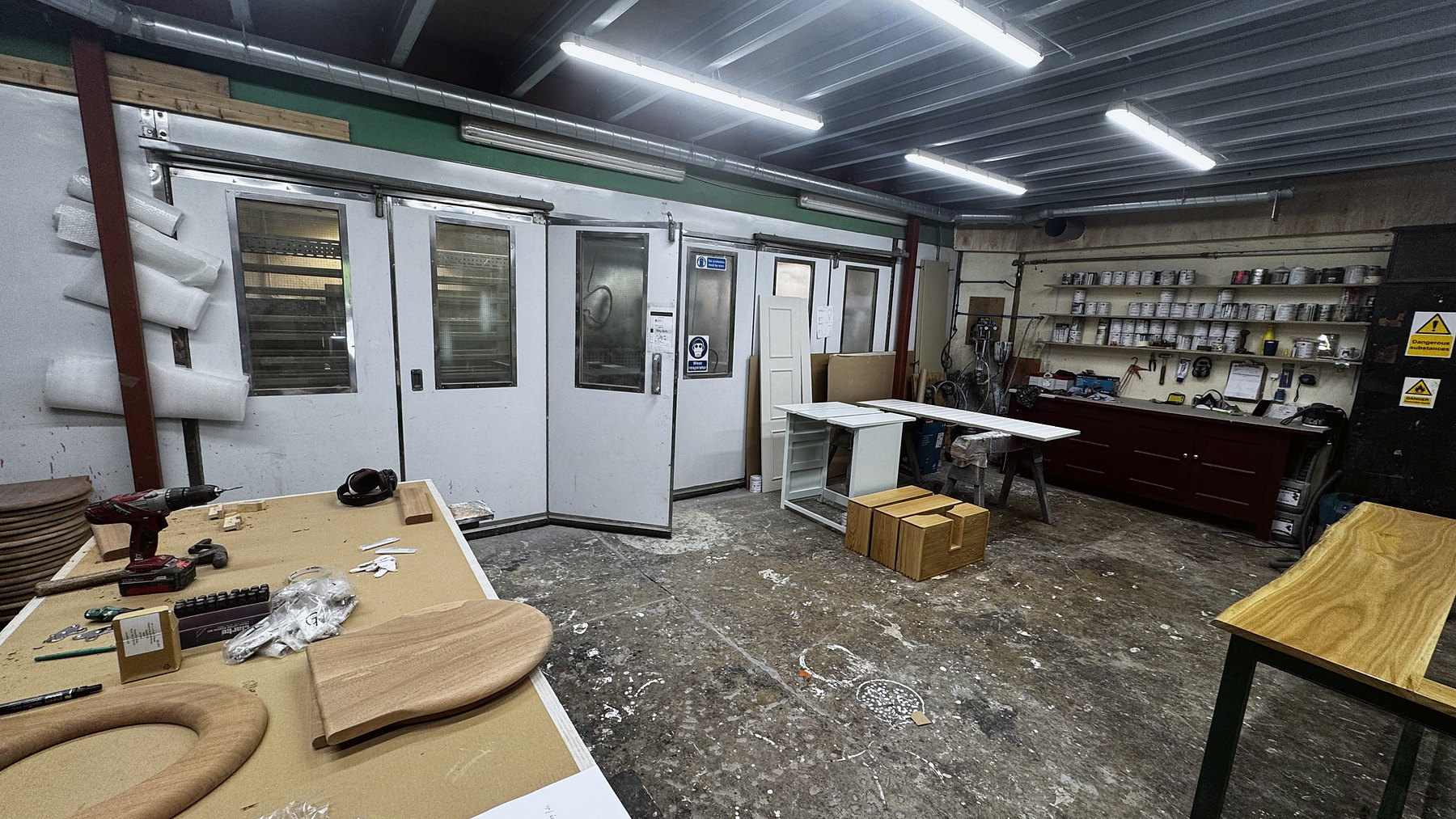
We finish everything ourselves, on site at Mickfield, in a booth built for the purpose: extracted, filtered, heated and lit for colour.
That matters more than it sounds. A workshop that sends painting out has to package unfinished doors, send them fifty miles, wait, and accept whatever comes back. We can spray a door in the morning, look at it in the afternoon, and cut it back and do it again if it is not right. Nobody has to be told.
Our polisher and spray department
Finishing is done by a trained French polisher and a spray manager. He is the only person who finishes our work.
A dedicated in-house French polisher is not something every kitchen workshop has. Having one man do every board means the sheen matches across forty doors made over five weeks, and it means the person who mixed the colour is the person who will touch it in at handover.
He also makes every sample. Brushed out on the actual door profile, in the actual paint, so you judge the colour on a moulding under your own kitchen light rather than on a card.
Sprayed or hand-brushed
Both are proper finishes and neither is a compromise. They look different, so we show you both before you choose.
Sprayed gives a flat, even, almost seamless surface. It suits contemporary work, plain slab and shaker doors, and any colour where you want the form read before the surface. It is quicker, so it costs less.
Hand-brushed leaves the faintest laid-off brush texture. On a run of in-frame doors in an old house it looks correct in a way a sprayed finish never quite does, and it catches light along a moulding. It takes longer, coat for coat, and adds ten to twenty per cent to the painted work.
Both are primed, filled, denibbed and flatted between coats. The difference is the last stage, not the preparation.
Colour
Any colour you like, matched to RAL or NCS, or matched by eye to a card or a sample you bring us. We make the board in the real timber and the real system before anything is committed.
Bespoke mixes where you want something that is not in either book. Bring us a fragment of a curtain, a piece of glazed tile, a smoke-stained skirting from the room we are working in.
We match to RAL and NCS references, which is usually what an architect or a main contractor will specify on a larger scheme.
Matching a colour
Matching is done by eye, against the sample, under the light the piece will live in. A spectrophotometer will get close; it will not account for the fact that a colour on a flat card and the same colour on a beaded panel are not the same colour.
So we mix, brush out, look, adjust, and look again the next morning. Two or three iterations is normal for a difficult match. It is included.
We record the final formula against your job, and you leave with a labelled tin from the same batch.
Oil, lacquer and wax
Hard-wax oil for timber worktops and any surface that will be worked on. It sits in the timber rather than on it, so it is repairable: a burn or a ring is sanded and re-oiled locally with no line where the old meets the new.
Clear lacquer, sprayed, for interiors, shelving and anything that wants protection with no colour shift. Washed and limed finishes where a paler, chalkier oak is wanted. Fumed oak where a deeper one is.
We use water-based systems where the surface and its use suit them, and solvent-based where they do not. On a boot-room bench or a sink surround we will specify the coating that lasts, and tell you which we have chosen and why.
French polish
Shellac, applied with a rubber, built in many passes over several days. It is the traditional finish for fine furniture and for library and gun room interiors, and it gives a depth no sprayed coating reaches.
It is also the least robust finish we offer. It will not take standing water, heat or alcohol. We will not put it on a worktop, and we will say no if you ask.
Where it belongs it is unmatched, and it revives by hand rather than needing stripping. It is done here, at the bench, alongside everything else.
| Finish | Where it goes | Repair |
|---|---|---|
| Hand-brushed paint | In-frame doors and frames in period and listed interiors | Touch in by brush from your labelled tin |
| Sprayed paint | Contemporary and plain-fronted work, large flat areas | Local flat and re-spray |
| Hard-wax oil | Timber worktops, tables, boot-room benches | Sand and re-oil locally. No witness line |
| Clear sprayed lacquer | Interiors, shelving, veneered panels | Flat and re-coat the whole component |
| Washed, limed, fumed oak | Oak where a paler or darker tone is wanted | Re-oil. Colour is in the timber, not the coat |
| French polish | Fine furniture, libraries, gun rooms | Revived by hand. Never stripped |
Start a conversation
Tell us about the room, the house and roughly when you would like to be cooking in it. We will tell you honestly whether we are the right people for it.
Make an enquiry