Timber
Which species we use where, why the cut matters more than the name, and where the boards actually come from.
How we buy
In the board, not in the pack, and wherever possible chosen off the rack rather than ordered by grade. Oliver Manning or Paul Sims goes to the yard for anything that will be seen: island tops, dresser fronts, a run of doors that has to read as one piece.
Everything is brought into the shop and left to acclimatise before it is cut. Kiln-dried stock for interior work at eight to ten per cent moisture content, checked with a meter, not assumed. Air-dried stock for anything going outside.
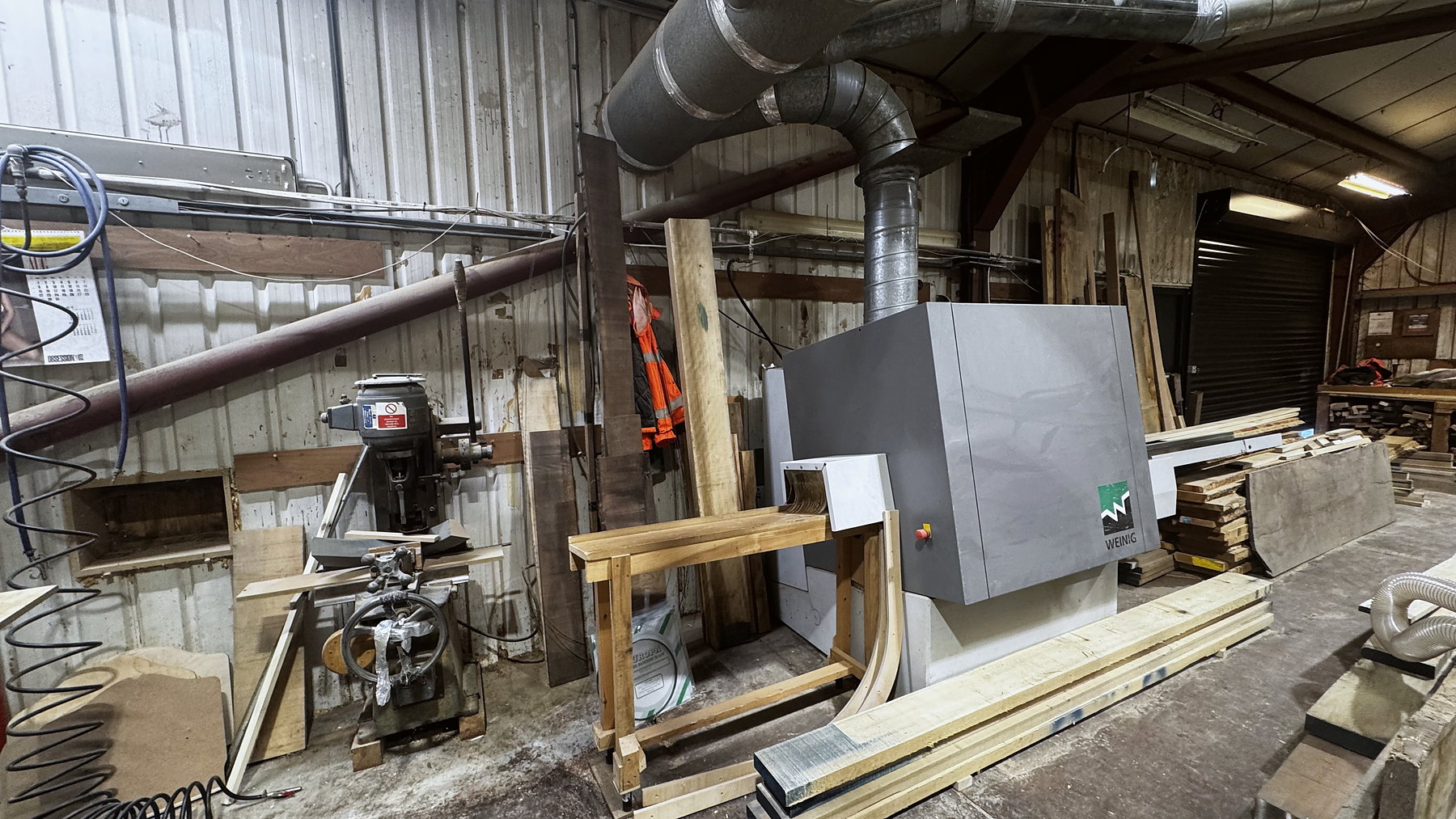
Offcuts do not go to landfill. They fuel the biomass boiler that heats the workshop.
Species by application
There is no best timber. There is a right timber for a particular job, and the choice is usually decided by how the piece will be used and finished rather than by how the board looks in a photograph.
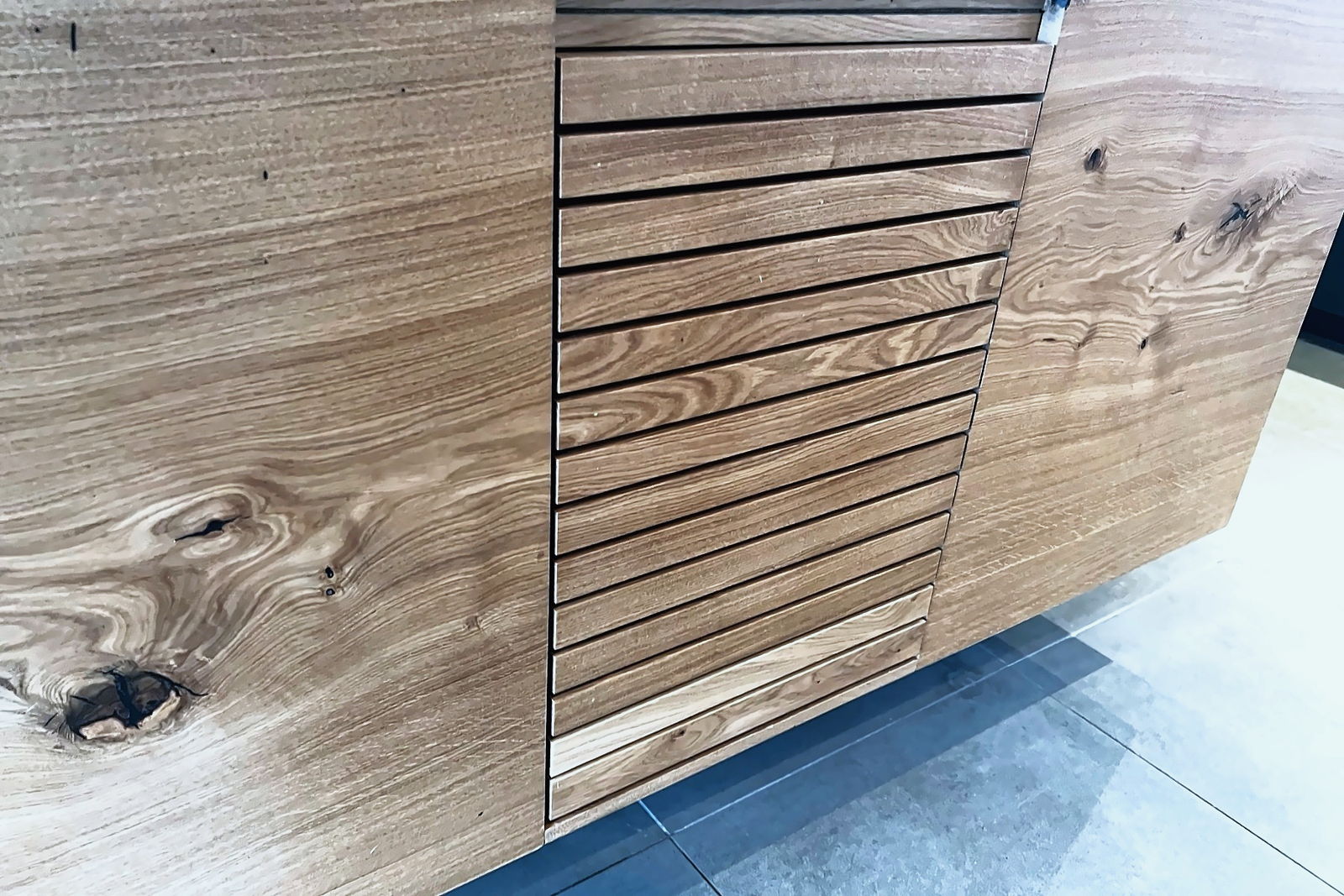
Painted work is the clearest example. A close-grained hardwood takes paint far better than oak, whose open pores telegraph through even a good finish. So most of our painted in-frame joinery is tulipwood.
Movement
Timber moves across the grain and hardly at all along it. A solid oak panel a metre wide can change by several millimetres between a damp February and a dry August with the heating on.
So panels float in their grooves and are never glued in. Wide tops are buttoned or slot-screwed so they can move against the frame beneath. End-grain butcher’s block is built to move as a unit. Breadboard ends are pinned, not glued through.
Underfloor heating and wood-burning stoves make rooms drier than most houses have ever been. We ask about both at survey and adjust the specification accordingly.
Quarter-sawn and crown-cut
Crown-cut boards come off the log tangentially. They give the wide cathedral figure most people picture when they think of oak, they yield more from the log and they cost less. They also move about twice as much across the width, and they cup.
Quarter-sawn boards are cut radially. Straight, tight, parallel grain, and in oak the medullary rays show as silver flecks across the face. They are more stable, more wasteful of the log and more expensive.
We use quarter-sawn where stability decides the job: door frames, long worktops, wide panels, anything in a listed interior that has to sit still for two hundred years. Crown-cut where the figure is the point, on a dresser back or a single-board table.
Book-matching and sequencing
Consecutive boards or leaves off the same log are opened out like the pages of a book, so the figure mirrors across the centre line. On a run of doors, or a set of library panels, it turns eight separate components into one piece of timber.
It only works if the material is kept in order from the yard to the bench. Boards are numbered as they come in, stacked in sequence and cut in sequence, and the rod records which leaf goes where.
Cabinet-grade veneered ply is treated the same way: book-matched and sequenced across a run, not laid up at random.
Sourcing, honestly
We buy through British merchants and from European mills. Where a mill holding recognised chain-of-custody certification can supply the section, the grade and the cut we need, we use it, and much of our European oak comes that way.
Some does not. A single wide elm board from a local yard, a parcel of air-dried English oak from a Suffolk sawmill, a piece of figured walnut bought because it was the right piece, rarely arrives with a chain-of-custody certificate attached.
So we will not tell you that every stick in your kitchen is certified, because we could not prove it. We can tell you which merchant or mill each board came from, and we will put it in writing if you ask.
| Species | Where we use it | Why |
|---|---|---|
| European oak, quarter-sawn | Frames, doors, islands, worktops, staircases, panelling | Stable, hard, and the default of English joinery. Fumed or limed where a darker or greyer tone is wanted |
| Tulipwood | Painted in-frame frames and doors | Close-grained and even. Takes paint without the grain telegraphing through |
| Walnut | Drawer fronts, library shelving, table tops, interiors | Dark, fine and stable. Works and polishes beautifully |
| Ash | Curved and bent work, gun rooms, sports and rod cabinets | Tough, elastic, takes steam bending |
| Cherry | Free-standing dressers and furniture | Fine grain, darkens with light over the first year |
| Sycamore and maple | Drawer boxes, drawer linings, pale interiors, inlay | Very pale, hard-wearing, no odour or taint |
| Iroko | Sink runs, wet areas, yacht joinery, external work | Oily and durable in water |
| Elm | Feature tops, single-board tables, breakfast bars | Wild interlocked figure. Bought a board at a time |
| Smoked larch | Boot rooms, cladding, external joinery | Colour through the section, weathers well |
| Eucalyptus | Veneered panels and contemporary door faces | Fine straight figure, takes a lacquer flat |
| Birch ply | Carcases, drawer bottoms, jigs and templates | High-grade, void-free, dimensionally stable. Not MDF, not particleboard |
Start a conversation
Tell us about the room, the house and roughly when you would like to be cooking in it. We will tell you honestly whether we are the right people for it.
Make an enquiry